

For this edition of Years Ago we review Utilities and Public Amenities as a topic and have looked at months April to June of the years 2001, 1951 and 1871.
What is expected today as a common basic commodity, service and facility was not always so.
2001
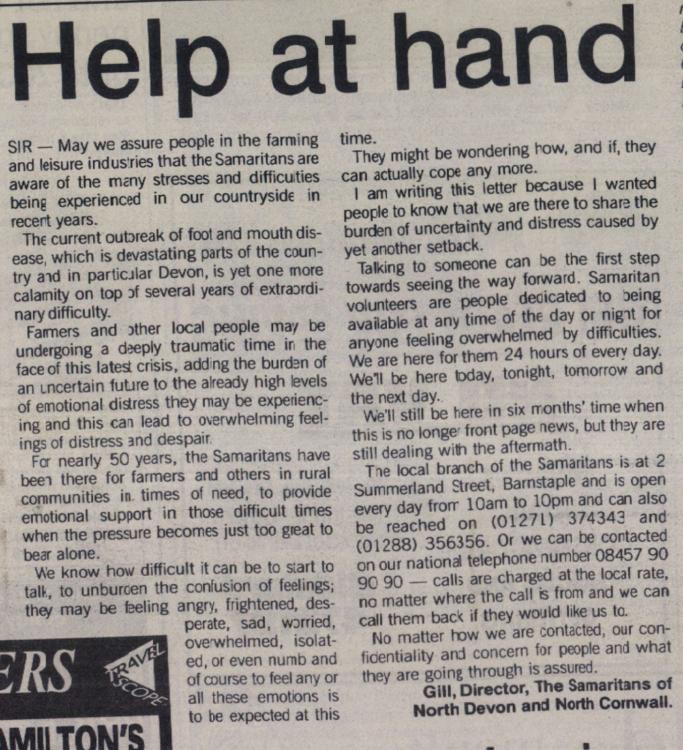
In the Spring of 2001 the foot and mouth outbreak, which lasted from February to September and resulted in the loss of 2 million cattle and sheep, had Britain in its grip. The paper carries an offer of help to affected farmers by the Samaritans. There is no doubt that the method of dealing with the disease in sheep and cattle by putting them down, then burning the carcasses on huge bonfires was really traumatic for the families involved.
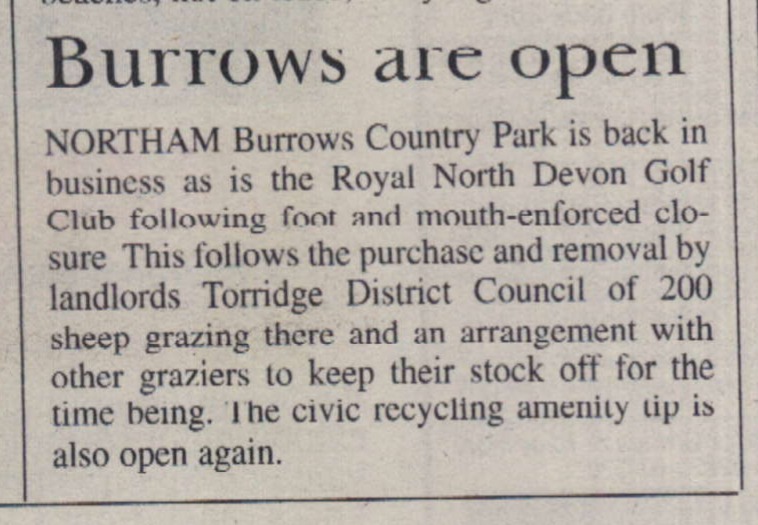
To mitigate some of the disruption, in May the council bought 200 sheep and removed them from the burrows so that the Burrows Park and the Royal North Devon Golf Club could reopen to the public. The public had been banned from walking in the countryside for fear of spreading the disease.
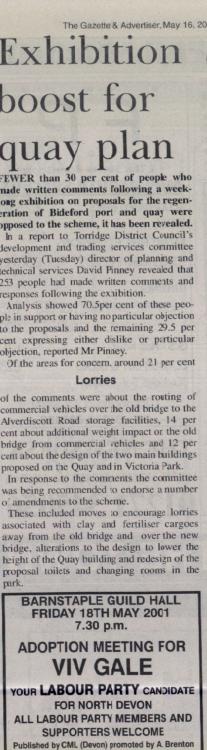
Following a proposal to increase industrial activity on the quay in Bideford a survey showed that a majority of townspeople supported the plans but there were real concerns over increased heavy traffic and damage to the Long Bridge.
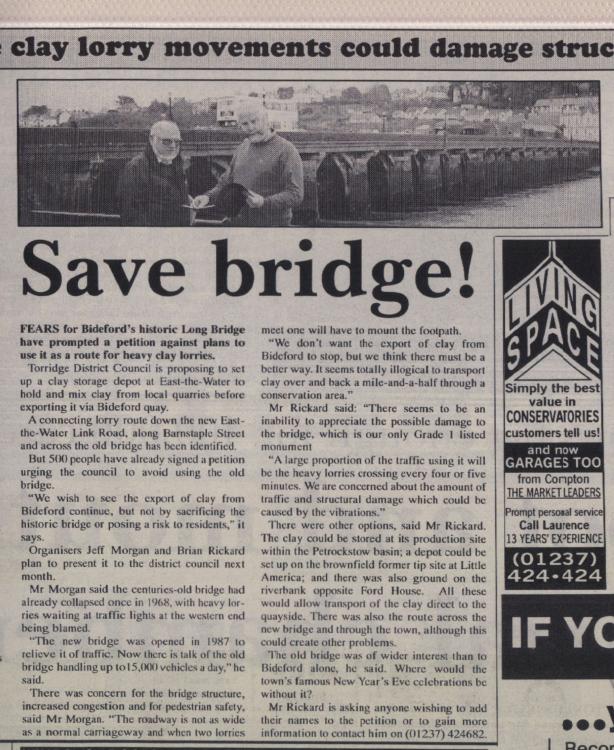
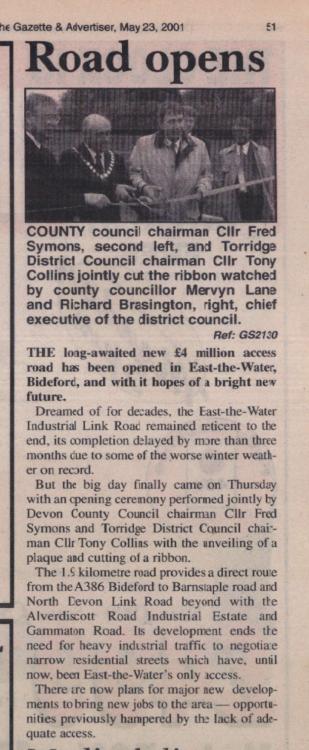
As part of the industrial regeneration of East-the-Water, a long awaited access road was opened to link the Alverdiscott Rd industrial estate to the link road. Perhaps this might help to ease the problem of heavy lorries on the Long Bridge?
Perhaps this article illustrates one downside to this welcome industrial development. It is good to see young people getting involved.
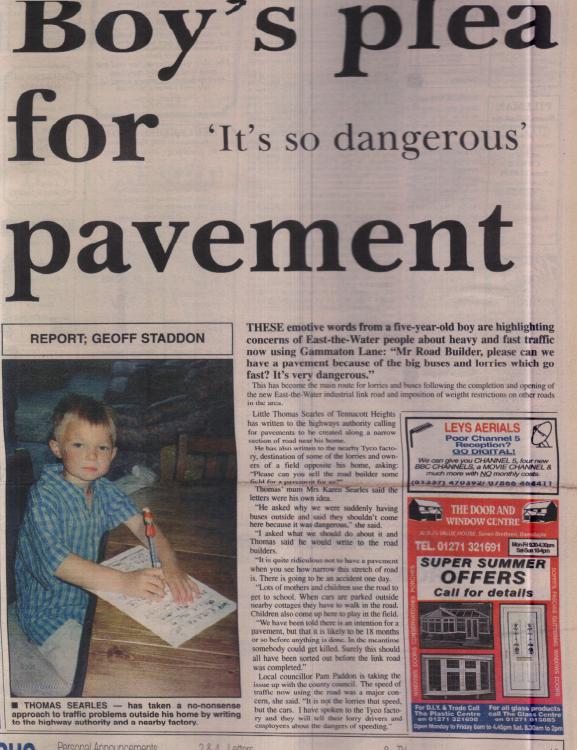
Thomas Searles
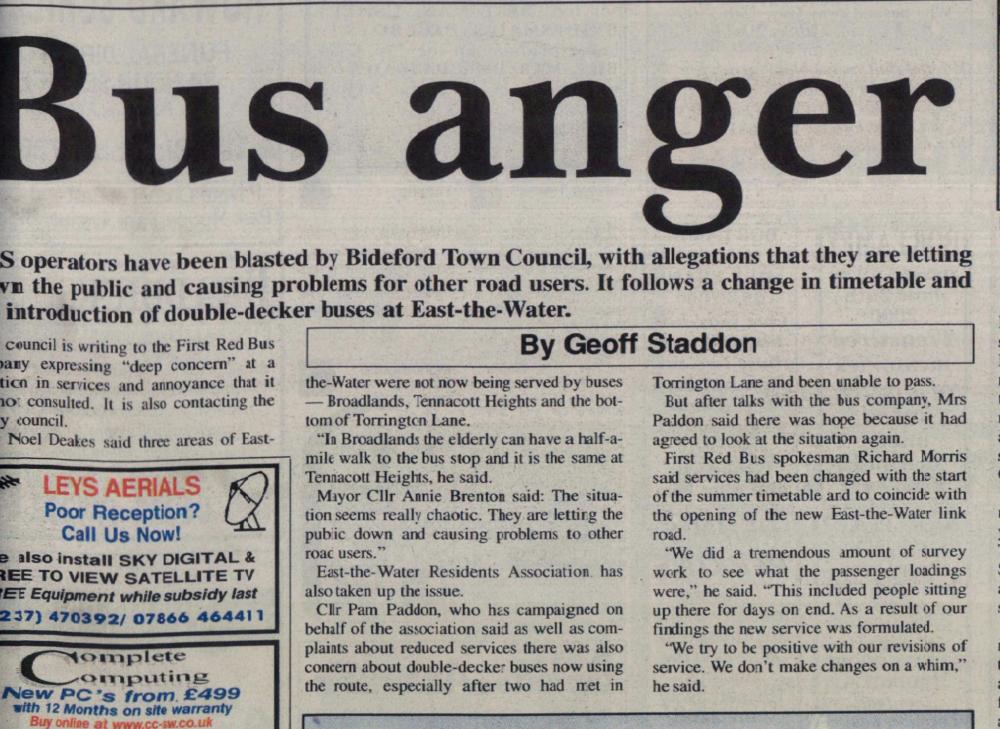
More disruption reported at East-the -Water
Railways continue to be a hot topic with the ambition these days of Bideford Council to reopen a line linking Bideford to Barnstaple and thence to Exeter. In 2001 an exhibition was held in the Burton Museum and Art Gallery to celebrate the short lived line from Bideford to Westward Ho! There are no plans at present to resurrect this line.

On the subject of loss of amenities Sheepwash and Chilsworthy lost their privately owned village shops and in May 2001 a plan was announced for the council to help set up Community shops in these villages. Are they still there?

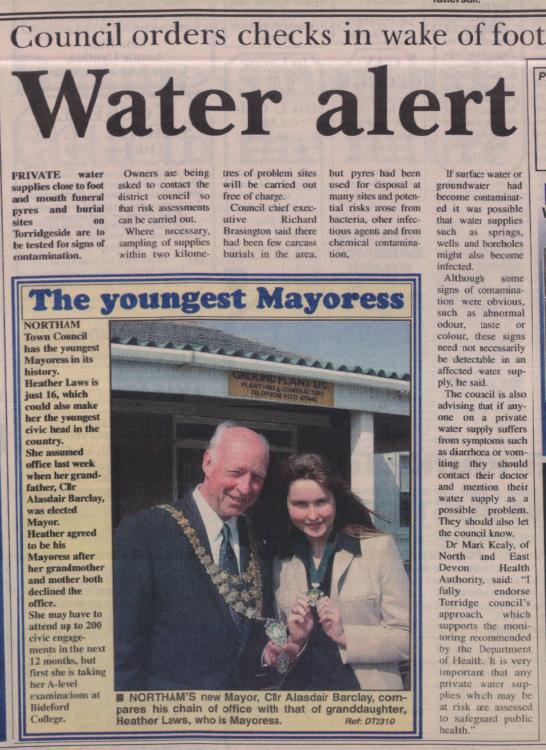
The next stories perhaps show heightened awareness about pollution and environmental damage, not surprising in the year when foot and mouth disease rampaged round the country. Firstly we have a story about concerns that the run off from foot and mouth funeral pyres may have polluted water courses.
The next story is about the rising popularity of bottled water. Is there a link?

Then followed up by a story of pollution killing fish.

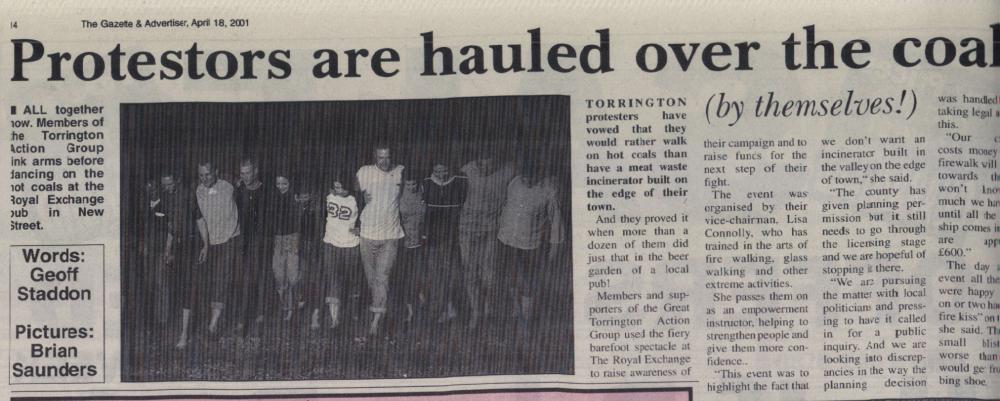
Possibly also related is a protest against a meat incineration plant in Torrington.
Littlejohns of Bideford, Coal Merchants, presented the Hoops Inn with an award and cheque for keeping the home fires burning with 5 coal fires at a time when many people were taking out their fires. The cheque was givcen to charity.
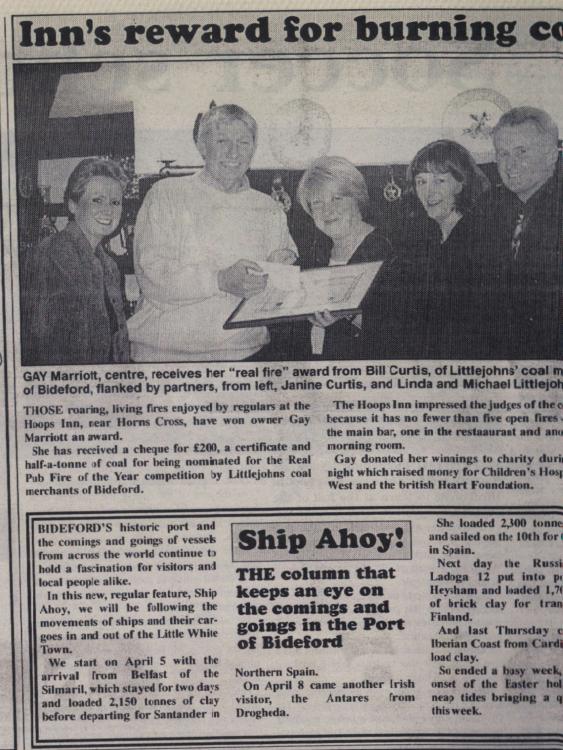
Gay Marriott, Bill Curtis, Janine Curtis, Linda and Michael Littlejohns
Home comforts were in focus with the government supporting schemes to make homes more energy efficient and insulate them. This is still a government initiative.

The next story is about “Meals on Wheels” originally they were provided by WRVS for people who had been bombed out in the Second World War but then they remained as a service for the elderly. Increasingly now this service is privatised and this story is about Home Farm Foods of Tavistock delivering frozen meals.

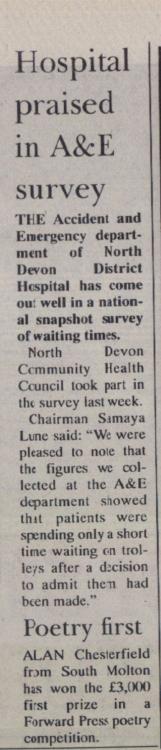
Good news about hospital waiting times in the next story, something we would like to see I’m sure.
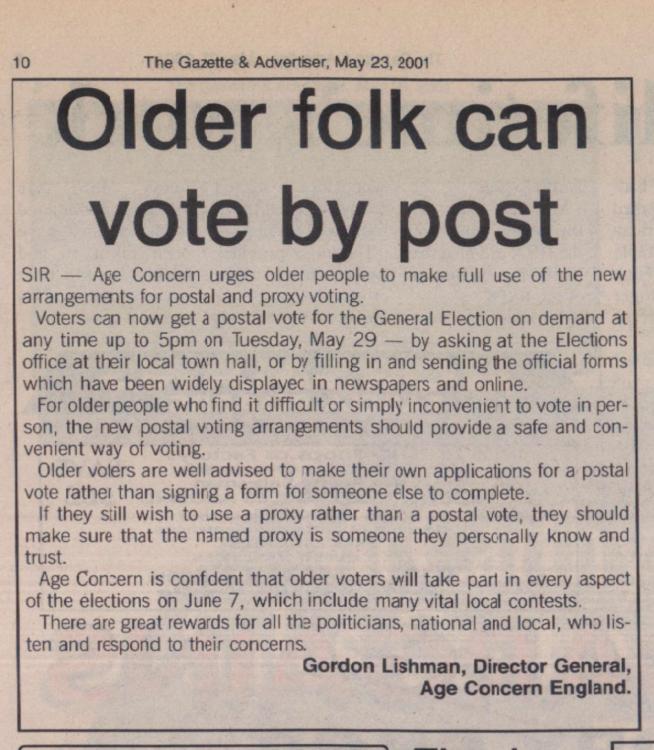
A couple of other stories, older people being encouraged to use their postal vote.
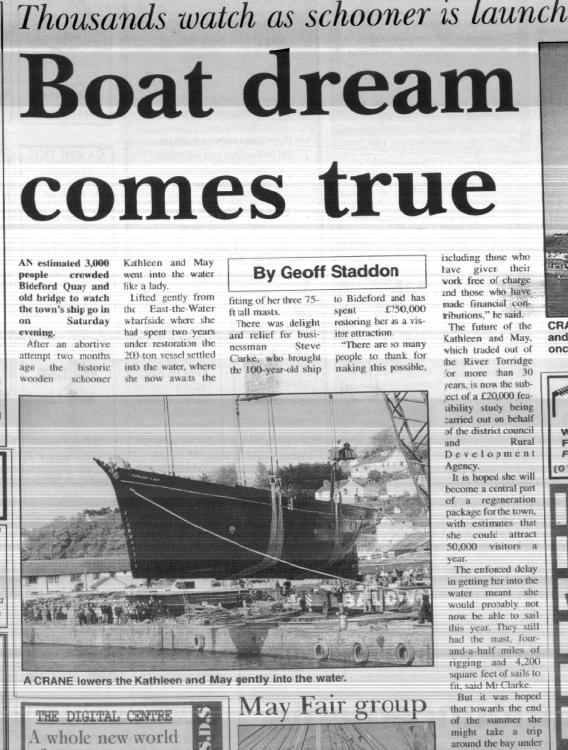
And finally good news about the Kathleen and May as 3,000 people crowd on the quay to watch her being refloated.
1951
Electricity and gas
Yelland Power Station
In the late 1940s and early 1950s, the East Yelland Power Station, a coal fired plant, is being built and was opened in 1955. The Station is situated approximately half way between the ports of Bideford and Barnstaple, and is bounded on the northern and western sides by the River Taw. There is a main single line railway and the power station is served by a turnout from the line.
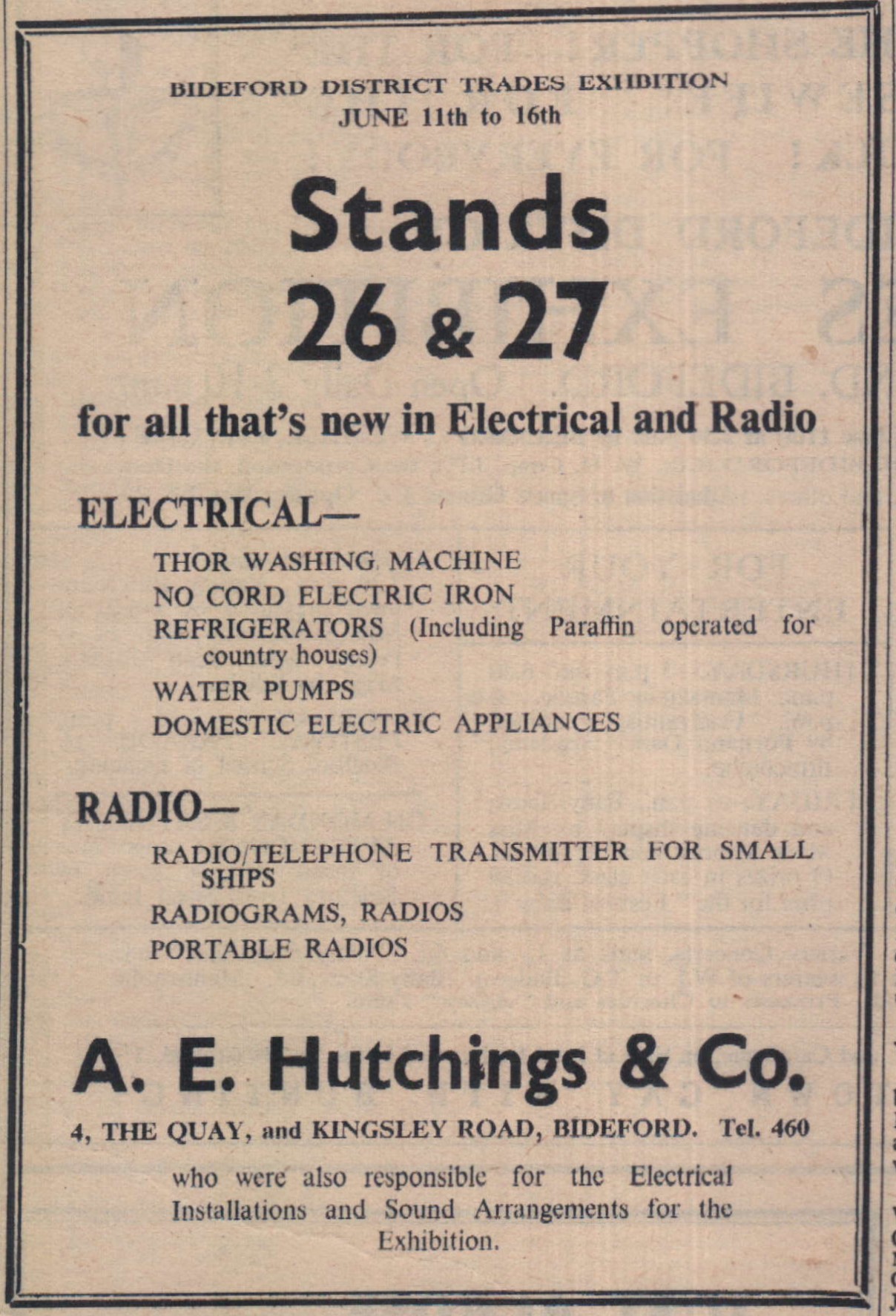
At the Bideford District Trades Exhibition in June 1951, A E Hutchings & Co demonstrates ‘all that’s new in Electrical and Radio’
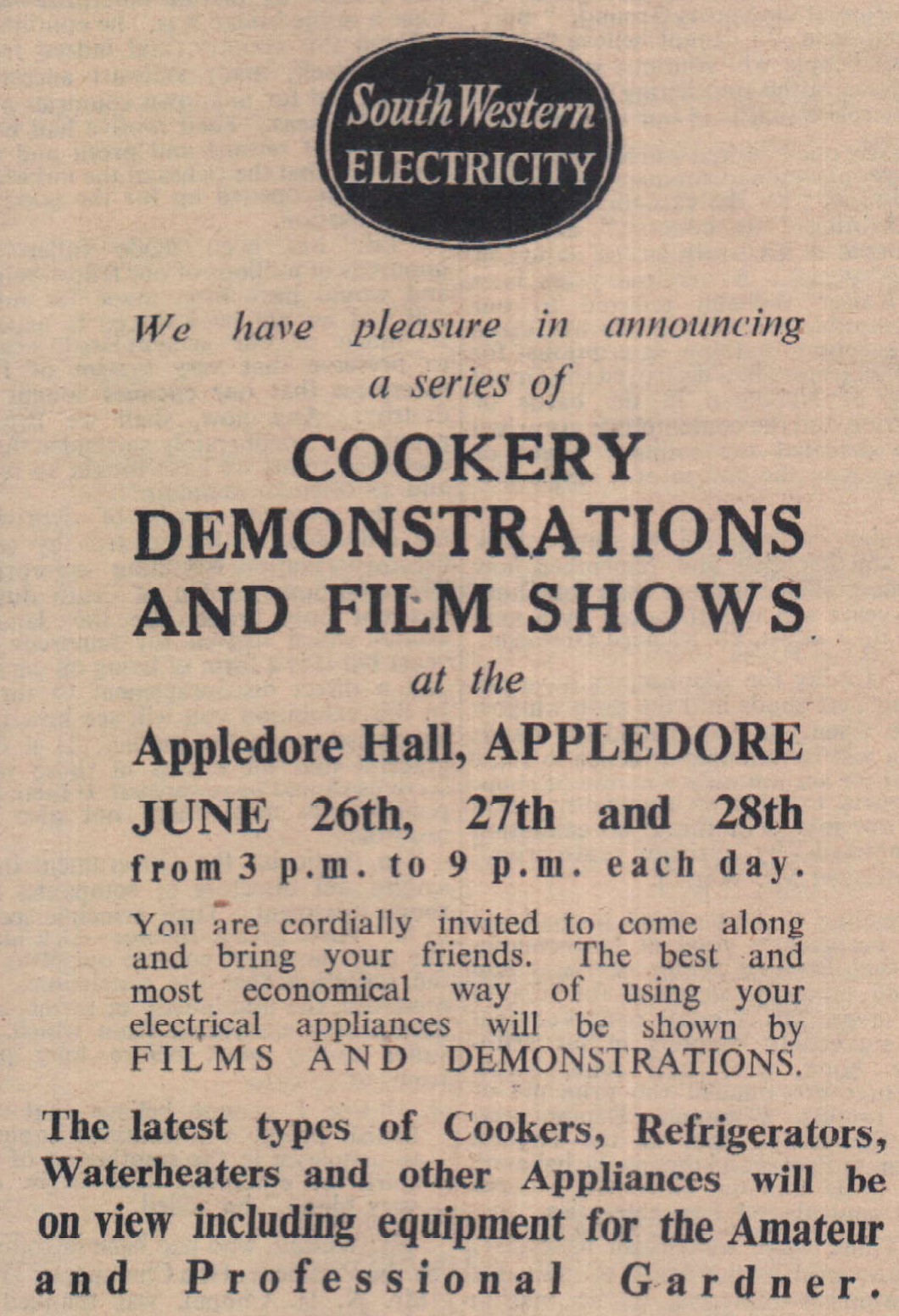
South Western Electricity plan ‘Cookery Demonstrations and Film Shows’ at Appledore Hall.
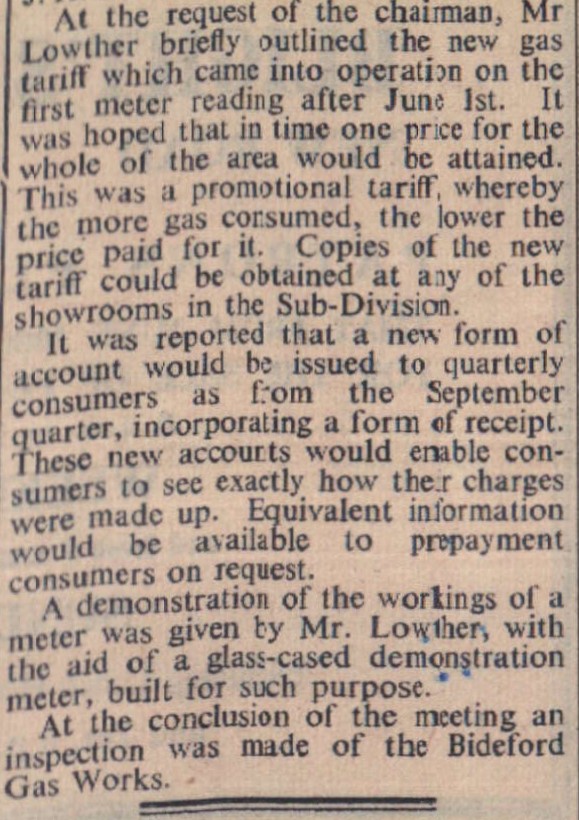
In 1951, the gas industry in the UK was nationalised and administered by regional gas boards, so a single, nationwide "new gas tariff" did not exist in the same way modern energy prices do. Instead, prices were locally set and subject to various statutory orders.At a meeting of the North Devon Local Committee of the South West Consultative Council, held at Bideford in June 1951, a ‘new gas tariff’ was discussed.
The South Western Electricity Board was the state owned regional electricity company operating in South West England, and which was later privatised. It was responsible for the purchase of electricity from the generator, and the distribution and sale of electricity to its customers.
Three men were charged with the larceny of a lead water pump valued at £8, the property of a man at Woolsery, and 56lbs of copper wire, valued at £11 4s, the property of the South Western Electricity Board. The three men were from Parkham, Bucks Mills and Buckland Brewer. An employee of the South-Western Electricity Board identified wire produced in court as similar to what had been used by him in laying a low voltage line. The wire had been stored on waste land or in the hedge at night. Two of the men were fined and the other was sent to prison.
In another similar case where a father and son were fined £5 each, “The Bench suggest that in future the South Western Electricity Board should be more careful in the collection and checking of scrap metals, but there is no excuse for employees helping themselves to what is left over,” declared the chairman of the magistrates, Mrs H W Fulford.
In April 1951, Bideford Town Council “decided to persist in their opposition to an overhead (Bideford-Bradworthy) electric line crossing the river Torridge. The Mayor, Cllr W H Short, thought they ought to fight to the last ditch. He did not like the idea of the line crossing the river when it could be put underneath.”
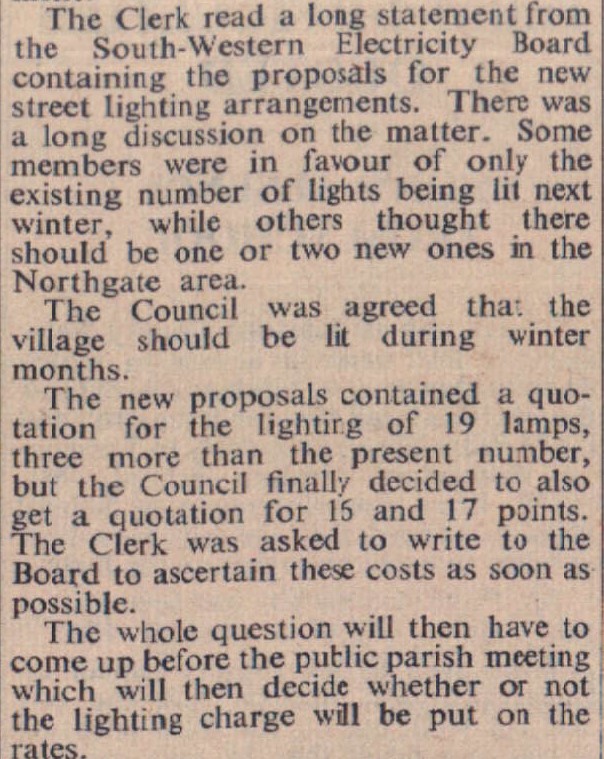
In May, Hartland Parish Council at their April meeting “decided to send a letter to the Harton Town Trust thanking them for the way in which they had undertaken the lighting of the town during the past five years. The Clerk stated that in spite of two letters and a ‘phone call to the Electricity Board, he had not yet received the quotation for the future lighting of the streets.”
In June at the Hartland Parish Council meeting, the issue of street lighting is discussed.
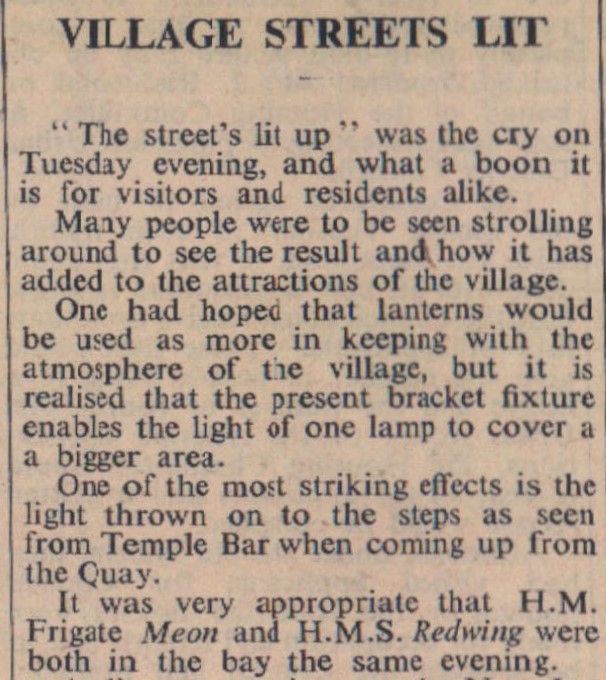
Clovelly Village streets lit
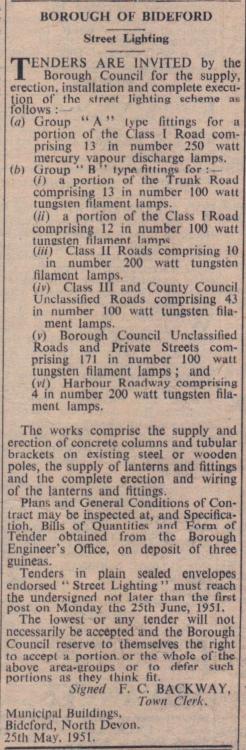
Bideford Town Council seeks ‘street lighting’ tenders in May 1951.
Calor is a brand of bottled butane and propane which comes in cylinders. The Company was formed in 1935 by a Cornishman, Ritchie Gill.
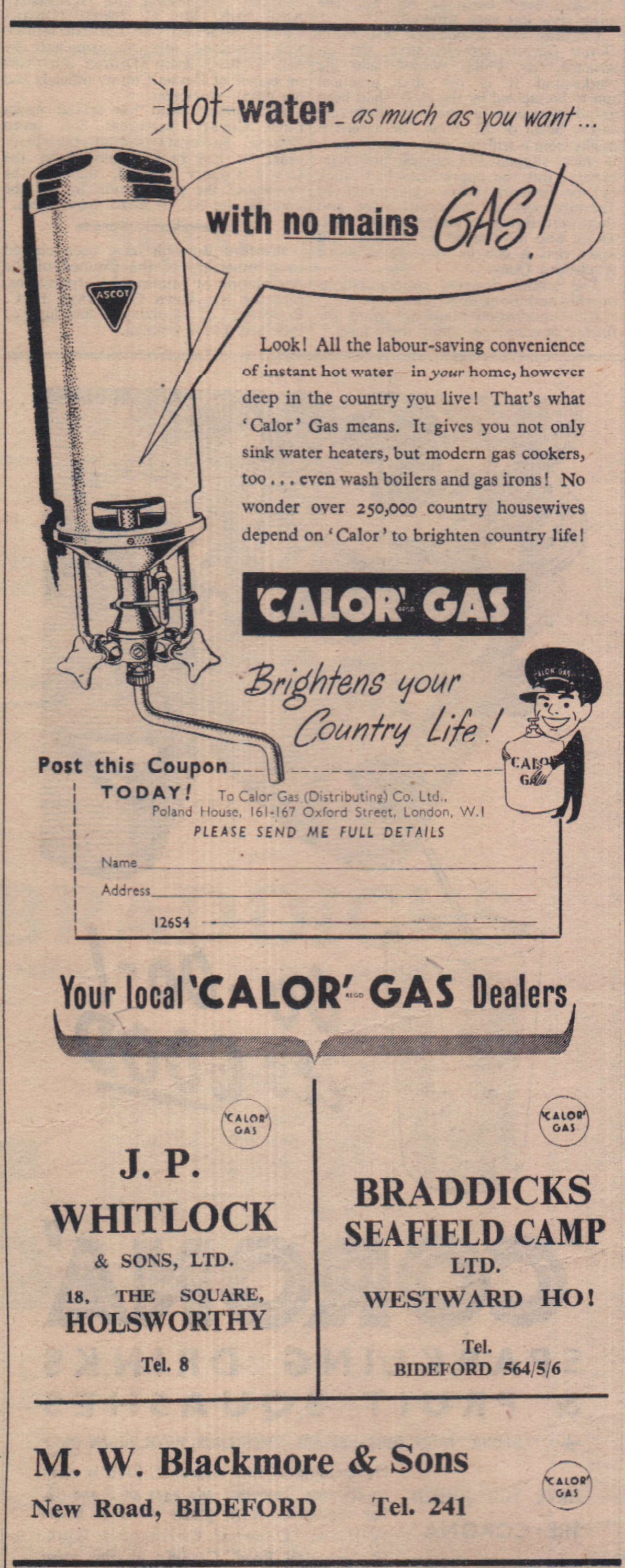
‘Calor’ Gas Brightens Your Country Life! Buy from J P Whitlock in Holsworthy, Braddicks Seafield Camp, Westward Ho! and M W Blackmore & Sons.
Communications
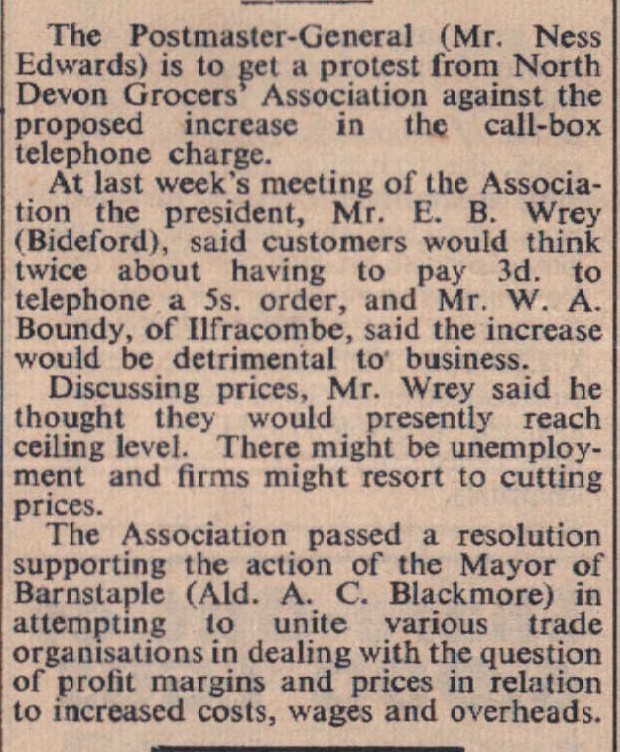
The Telephone Act 1951 (UK) was a British law empowering the Postmaster General to regulate telephone use and business, allowing him to set terms for telephonic communication and manage operations under his control, essentially strengthening government oversight of the burgeoning telephone system before later deregulation. This was the first Telephone Act passed by Parliament after the invention of the telephone, 75 years earlier.
In 1951, UK telephone call boxes, primarily the iconic red K6 design by Sir Giles Gilbert-Scott, were common sights, with local calls costing 3d for up to 5 miles, untimed on the A/B boxes, while new designs like the Noble Kiosk emerged for the Festival of Britain. They served vital communication, though faced initial criticism for their distinctive red colour - now a national cultural landmark. In the 1950s, in the region of 44,000 telephone kiosks were installed.
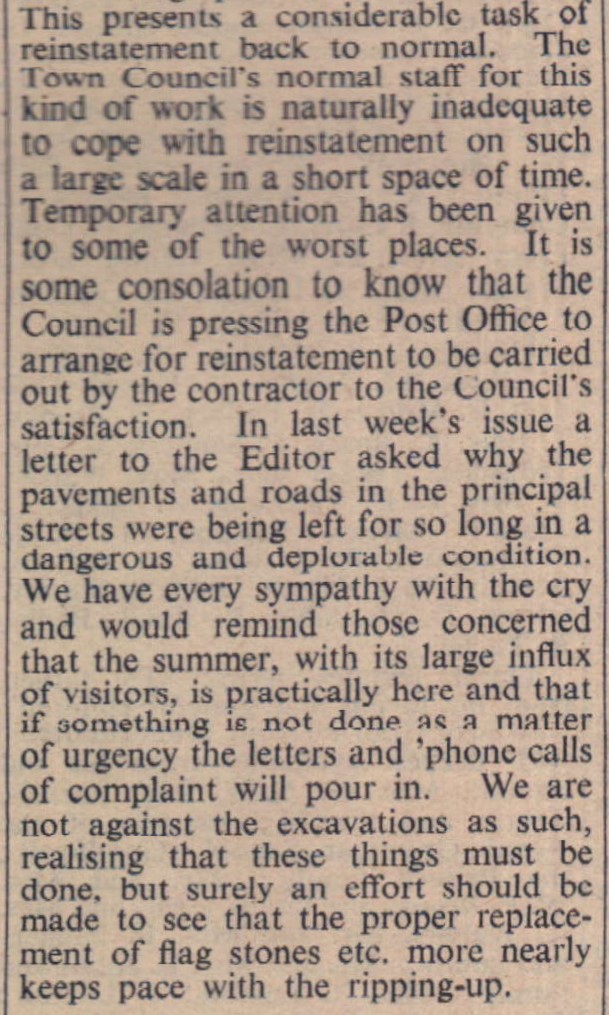
In June 1951, it is reported that “As a result of the excavations for the laying of underground cable ducts for the telephone service a number of Bideford pavements are in a very disturbed condition, hazardous to all and especially to old folk and those whose eyesight or agility is not of the best. It is understood that about three miles of excavations are taking place in the Borough.”
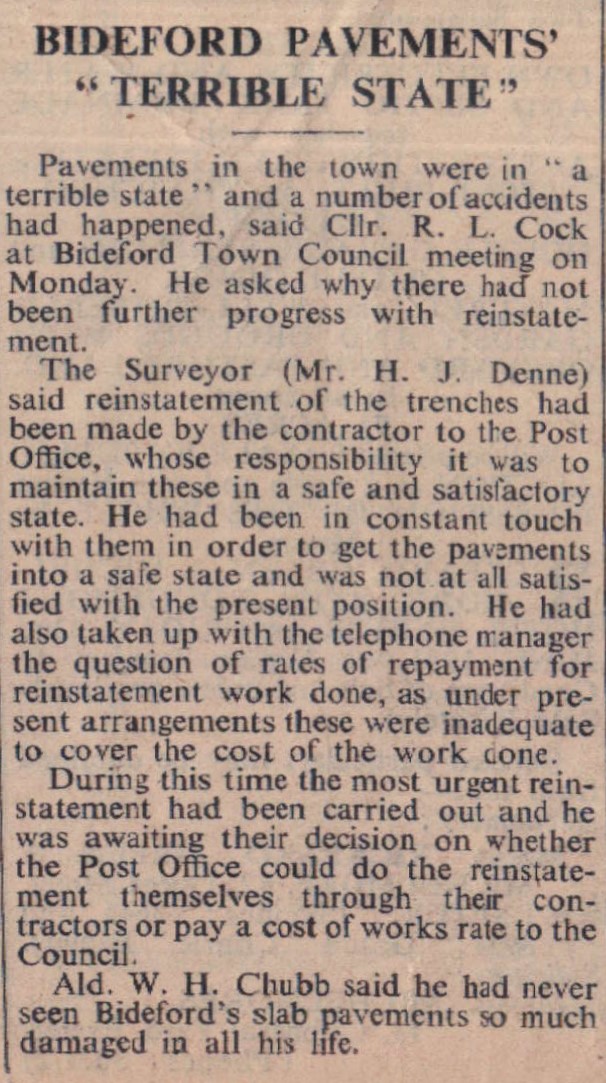
Later in the month, it is reported:
Sewage
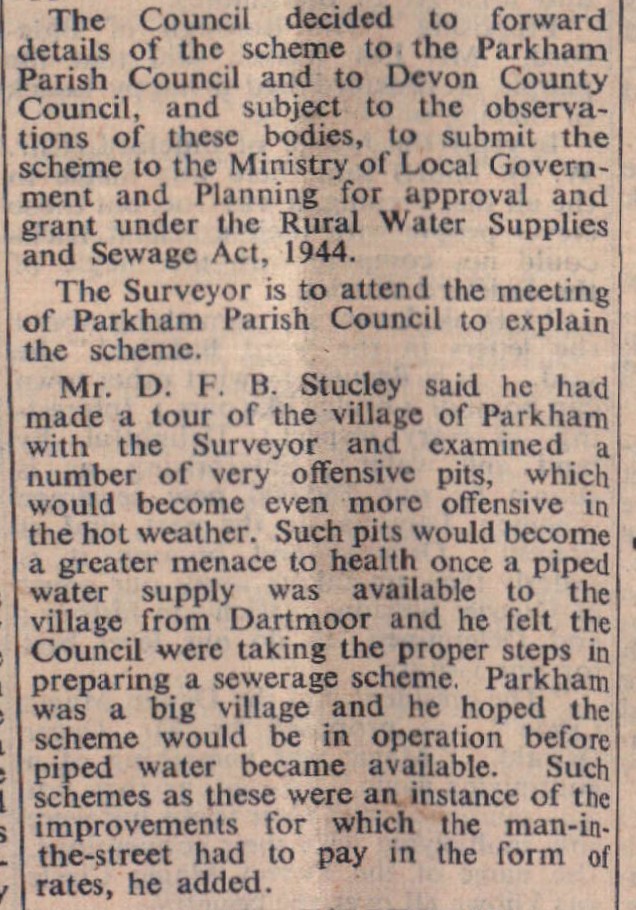
The Rural Water Supplies and Sewerage Act 1944, enacted during World War II, was designed to provide government financial assistance and create a framework for local authorities to extend piped water and sewage systems to rural areas, making these services a general responsibility and encouraging post-war development for better living standards. It established central government grants for rural water supply and sewerage projects, aimed at bringing urban standards to the countryside and placed a clear obligation on local councils to ensure water and sewage provision in rural areas, provided costs weren't unreasonable. Expenses for water, sewerage, and sewage disposal in rural districts could be classed as 'general expenses', rather than special expenses, for rating purposes.
Reported “Bideford Rural District Council approved in principle a scheme for sewerage and sewage disposal works for the parish of Parkham at an estimated cost of £4,590.”
Refuse
In the 1950s, scavenging generally referred to salvaging discarded materials for sale or reuse, an early form of recycling. Recycling was a way of life in the 1950s after the years of wartime austerity had taught people to 'make do and mend' and not waste anything. With few homes having the luxury of a freezer or even a fridge, shopping was generally done on a daily basis with fruit and vegetables sold loose and seasonal produce. Housewives may have had their groceries delivered to the home by bicycle with a basket on the front. Milk, delivered by the milkman, came in glass bottles with silver foil lids, and the bottles would be returned to the milkman after being washed out. Old newspapers were re-used - cut into squares for toilet paper or rolled and tied to form paper 'logs' to light the coal fire. Vegetable peelings went on to the garden compost heap or given as animal feed.
“On the recommendation of the Health Committee, the Council decided to seek the views of all Parish Councils on the question of an organised district refuse collection. The question of refuse collection has been considered by the Council on many occasions and each they had rather flinched at the prospect of the expense, said Mr D F B Stucley. Recently, however, the cost of scavenging had been accepted as a district rate, which meant that the whole district was now paying the cost of scavenging in those areas where an organised collection was made.”
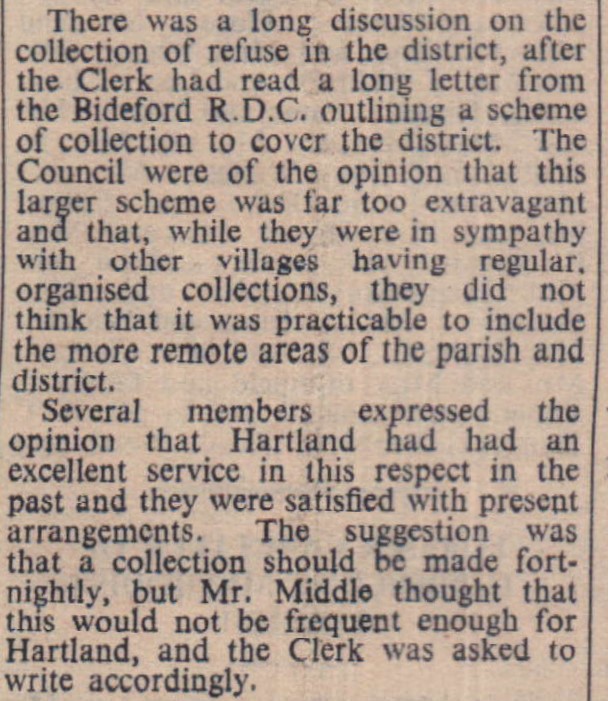
At a Parish Council meeting in Hartland, June 1951, the issue of a refuse collection was discussed.
Water Supply
Water supply varied significantly with many rural homes lacking indoor facilities and relying on communal pumps or wells. Post war, the government actively promoted rural water schemes. Before 1973 water and sanitation services were provided by water undertakings and sewerage and sewage disposal authorities respectively, and until the 1950s there existed over a thousand water undertakings, with administrative boundaries similar to those of local government boundaries.
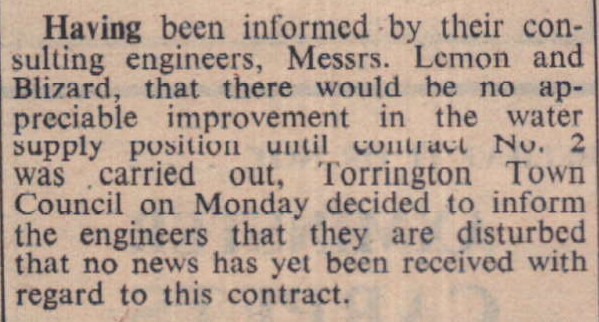
“Formal consent by the Ministry of Local Government and Planning to the raising of a loan of £11,866 for works of water supply was reported to Torrington Town Council by the Town Clerk, Mr S J Parkes). In May, it was reported “Work on the number one contract of the town’s new water scheme was proceeding ‘as well as could be expected in the circumstances’ reported the Surveyor (Mr C W Glover) to Monday’s meeting of Torrington Town Council.”
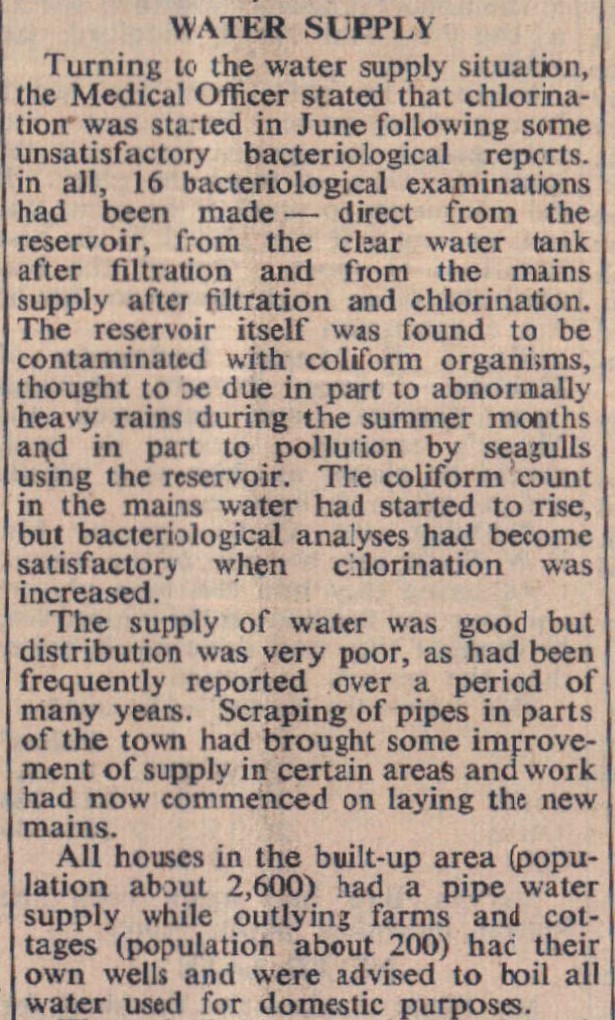
At a Torrington Town Council meeting in May 1951, the Medical Officer reported on the water supply situation:
“Bideford Town Council last week recorded their satisfaction that a personal letter from the Mayor to the firm concerned had considerably speeded up the delivery of water main pipes needed for the old people’s flats at Newton Road.”
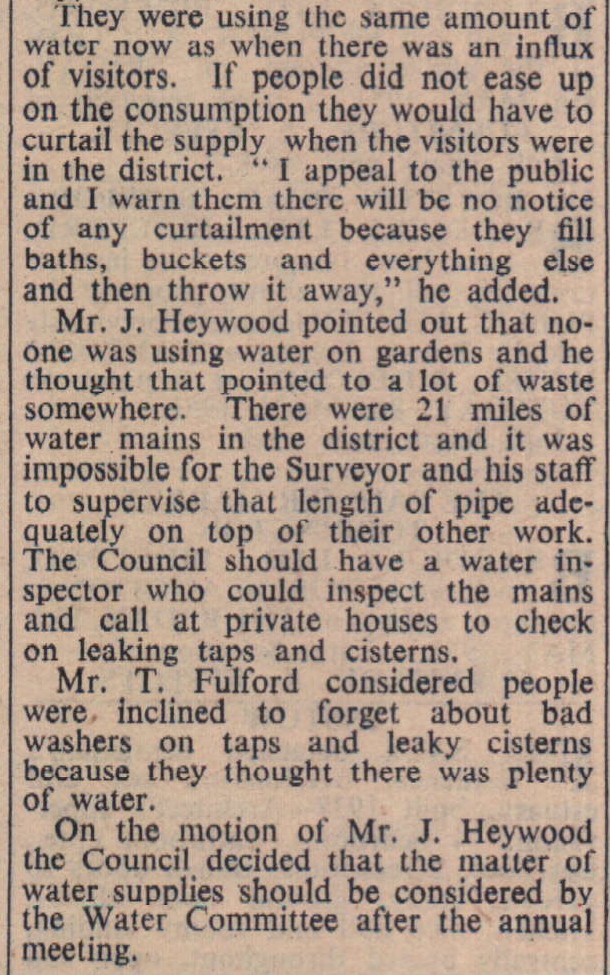
“There would be no warning given to householders if it was found necessary to curtail the water supply during the holiday season, declared the Surveyor, Mr A Brewer, at last week’s meeting of Northam Urban Council, when he reported that water consumption in the district was at the rate of 50 gallons per head per day. During the month of March 8,882,000 gallons has passed through the meters at the Council’s reservoir at Melbury for consumption in the district he stated. This was an increase of 677,000 gallons per month and 21,838 gallons per day compared with the corresponding month of last year. The mains were being tested for leaks, but it seemed that there was more water being used since he had given a warning a month ago. “People are using up to nearly 300,000 gallons a day and that is 50 gallons to each person in the district and we are having to put the booster pump on every other day” he added.” A report the following month:
It is calculated that, on average, a person in the UK now uses 37-45 gallons of water per day.
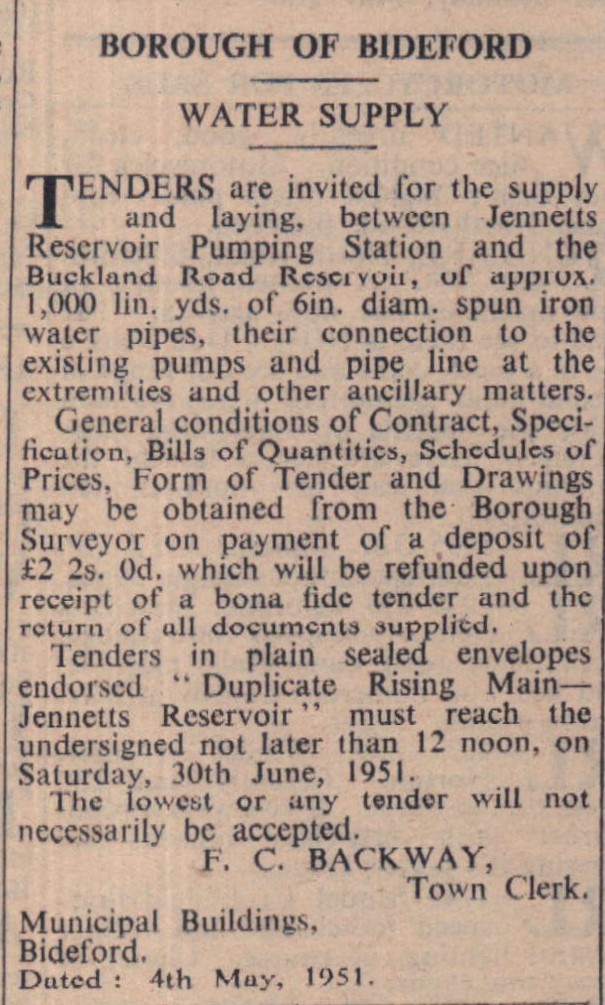
In May 1951, Bideford Town Council seek tenders for the laying of water pipes between Jennetts Reservoir Pumping Station and Buckland Road Reservoir.
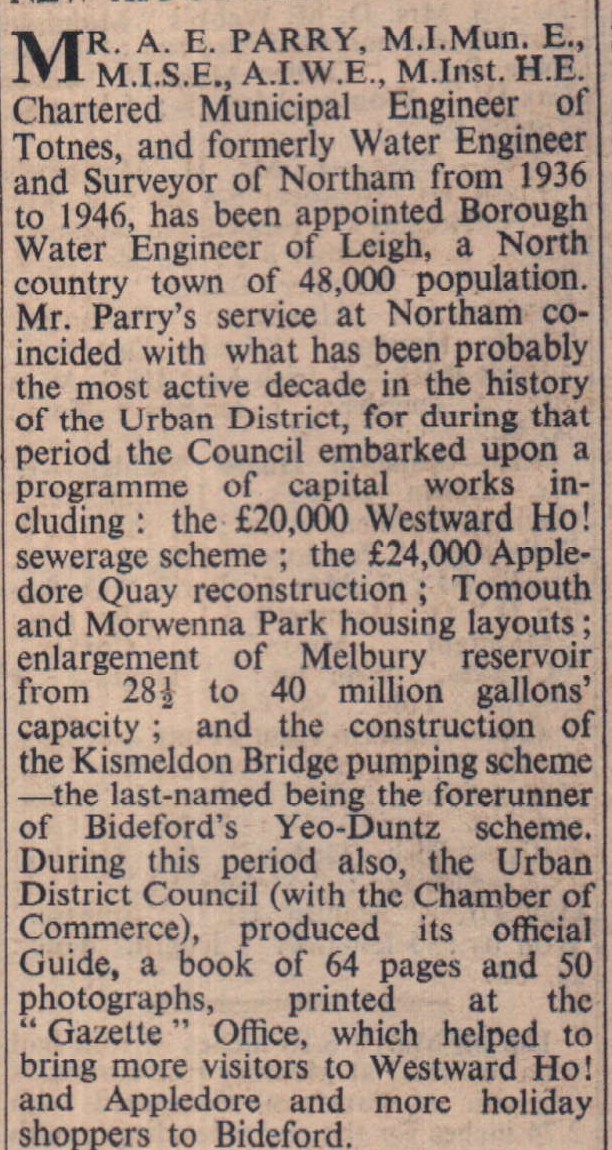
Mr A E Parry, M.I.Mun. E,. M.I.S.E,, A.I.W.E., M.Inst. H.E. formerly Surveyor of Northam takes on a new job.
Rates
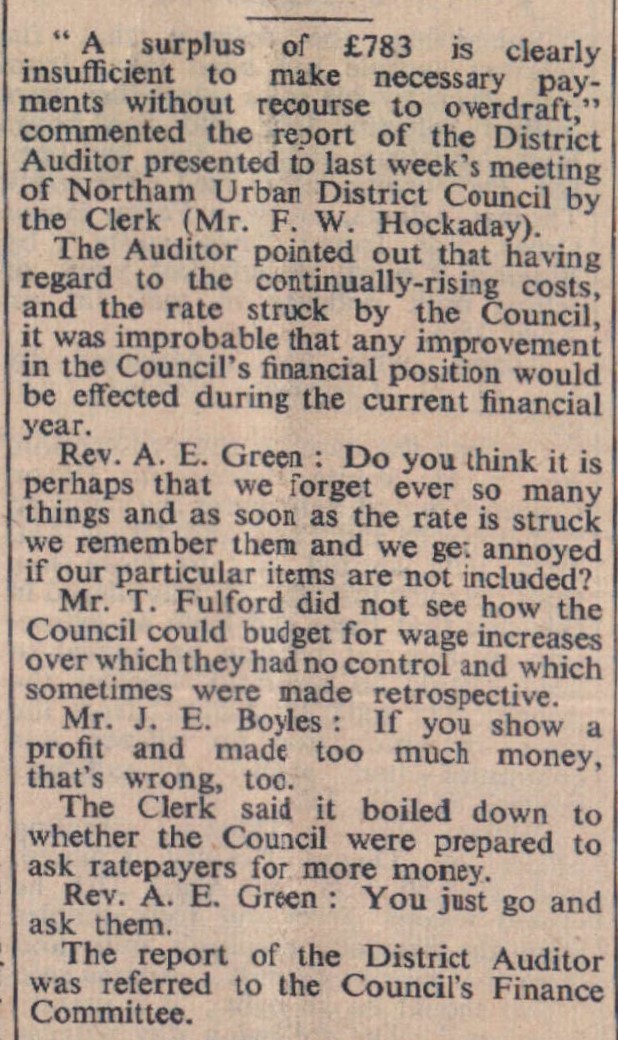
It isn’t a modern day issue where councils cannot reconcile their audit books.
"Prospect of overdraft. Auditor’s hint to Northam Council."
Parking charges
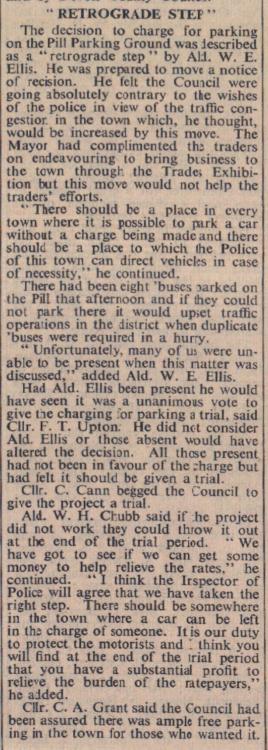
“Following notice of motion by Alderman W H Chubb, Bideford Town Council agreed that, for a trial period from July 1st to September 30th, a charge should be made for parking on the Pill Parking Ground with an attendant on duty from 12 noon to 8pm. Charges approved were: Motor cycles 3d; private cars, 6d; chars-a-banc and omnibuses, 1s 6d. The Mayor, Cllr W H Copp, and the Town Clerk, Mr F C Backway, reported that they had interviewed the Inspector of Police who, while emphasising that the question of making a charge or not was entirely a matter for the Council to decide, had expressed the view that free parking would tend to reduce the number of cars parking in the streets of the town and so alleviate traffic difficulties. Fourteen proprietors of hackney carriages had protested against the proposal of the Council to move the hackney carriage stand to the opposite side of the Quay as part of general traffic control reorganization, reported the General Purposes Committee.”
Not everyone agreed with the decision...
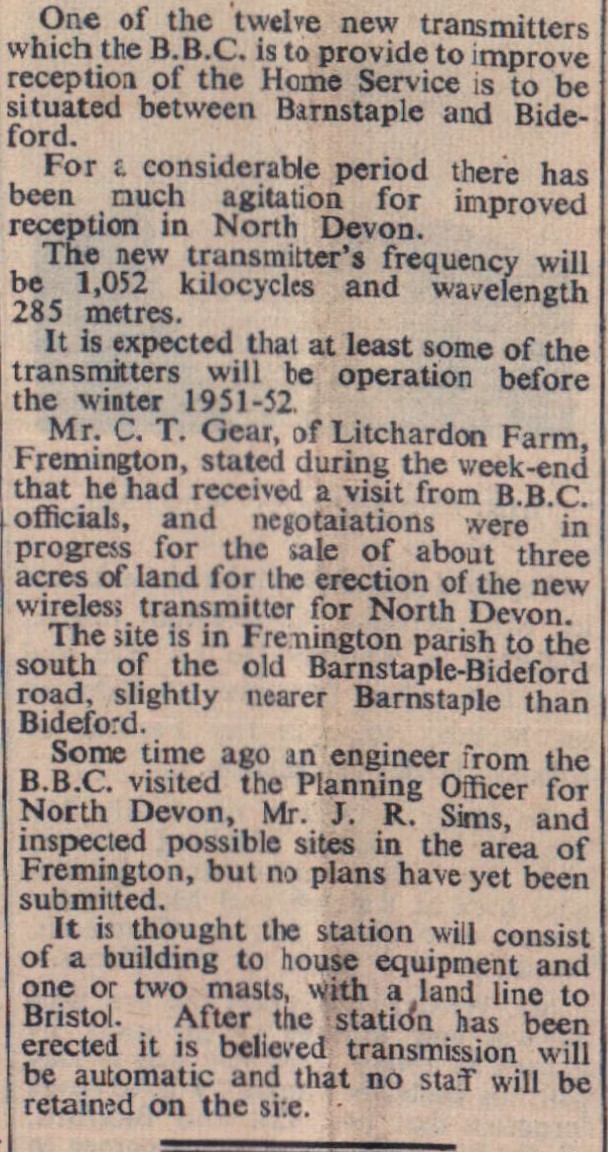
North Devon to get new transmitter to improve BBC Home Service reception
1871
The 1871 census reveals, as well as an increase in the population, an industrial workforce supporting infrastructure, including masons, shipwrights, and wheelwrights, particularly in coastal and growing areas like Appledore.
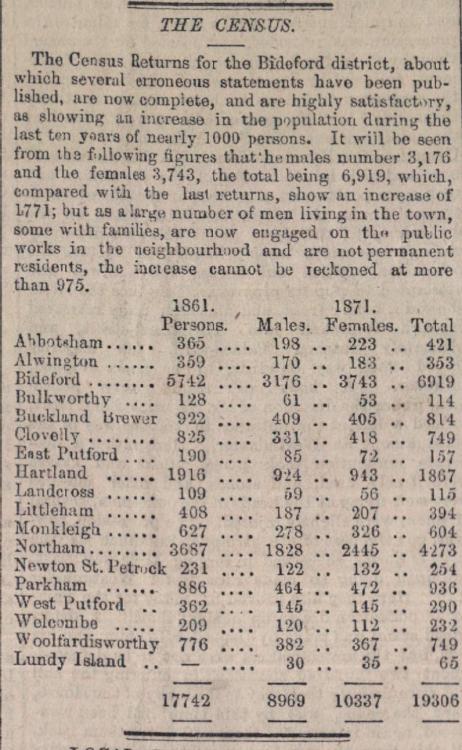
Sanitary Conditions of Bideford, Northam and Appledore
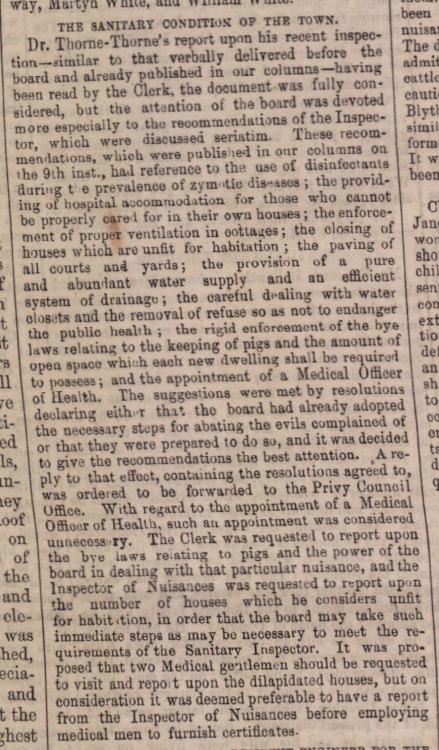
The Inspector of Nuisances (the precursor of today’s Environmental Health Officer) was concerned about the lack of drainage provision for residents. Drainage was a serious issue due to the high number of cases of Zymotic Diseases in the area. Zymotic disease is an old name for acute contagious infections. Now referred to as Germ Theory. Zymotic diseases included Typhoid, Cholera, Typhus, Measles, Scarlet fever and Diphtheria. These infections are spread through contact and poor living conditions. Due to the high number of deaths in the area in 1870, the medical officer, Dr Thorne-Thorne, was asked by the Privy Council to undertake an investigation.
The death rate was 33 per 1000 due to water-bourne disease. The town was in special need of every sanitary assistance.
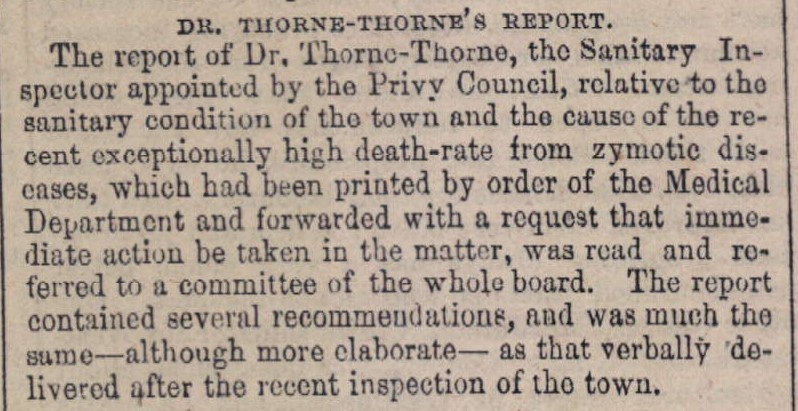
Dr Thorne-Thorne’s recommendations for Bideford.
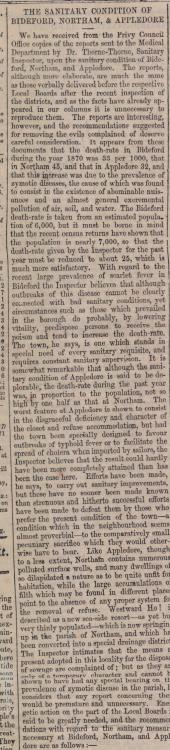
Dr Thorne’s recommendations for Northam and Appledore. Northam was disease central due to the numerous contaminated wells in the area.
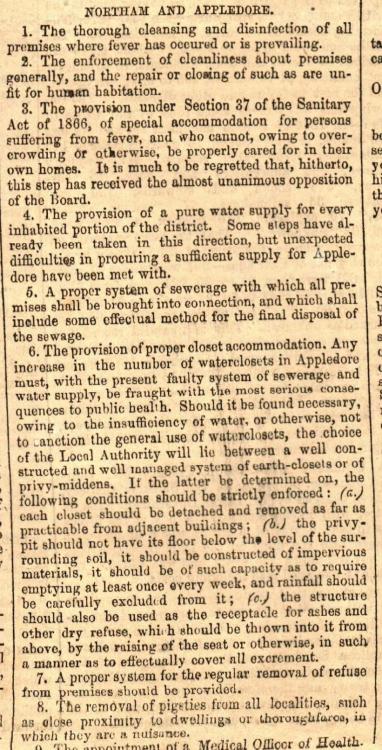
As with our recent Covid experience, disinfectant was paramount. However, as there was no running water, hand washing wasn’t mentioned. And finally ...
Housing
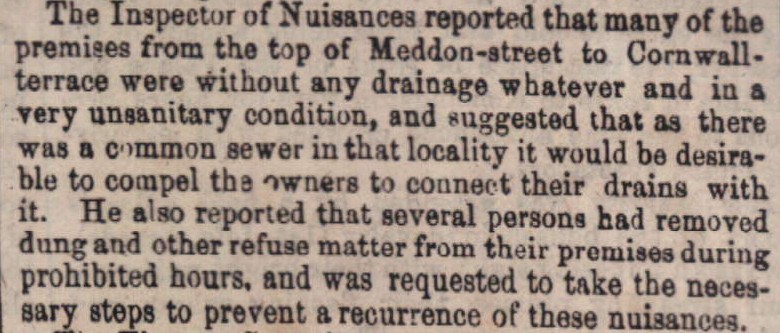
Some concerns of the Inspector of Nuisances, Mr Vanstone, about premises in Meddon-street to Cornwall-terrace.
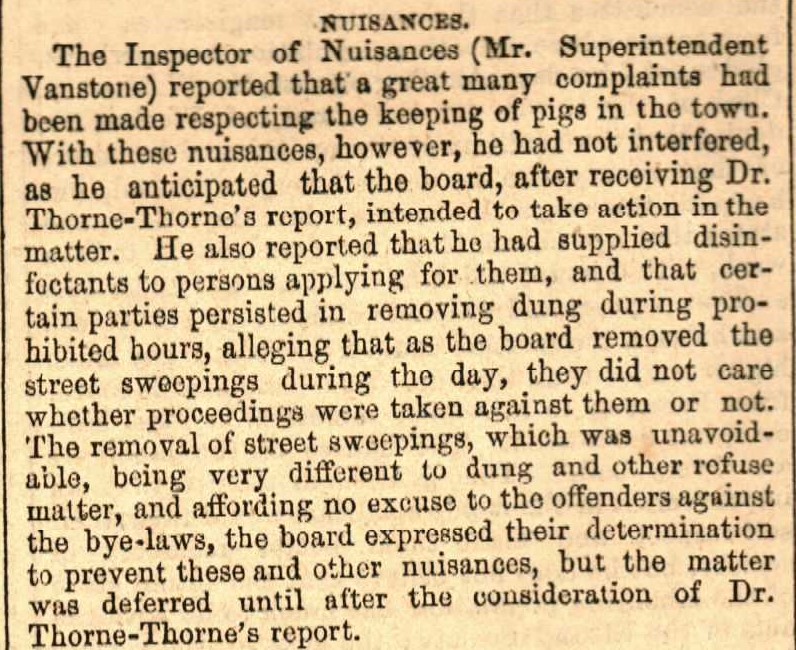
Imagine keeping pigs in a residential area nowadays!
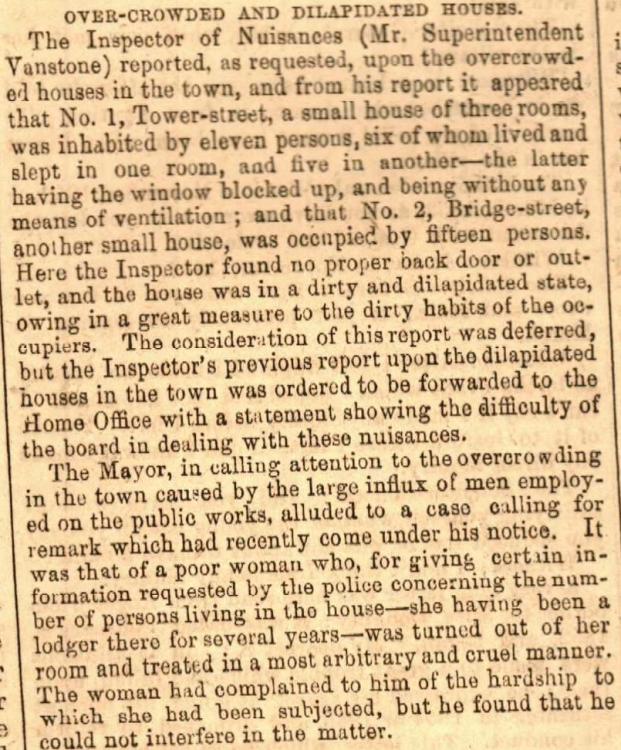
Overcrowding was a serious issue due to lack of accommodation and finances, as well as the influx of labourers dealing with the new drainage system. Nos. 1 Tower-street and 2 Bridge-street are mentioned in this report ...
New drains for Bideford
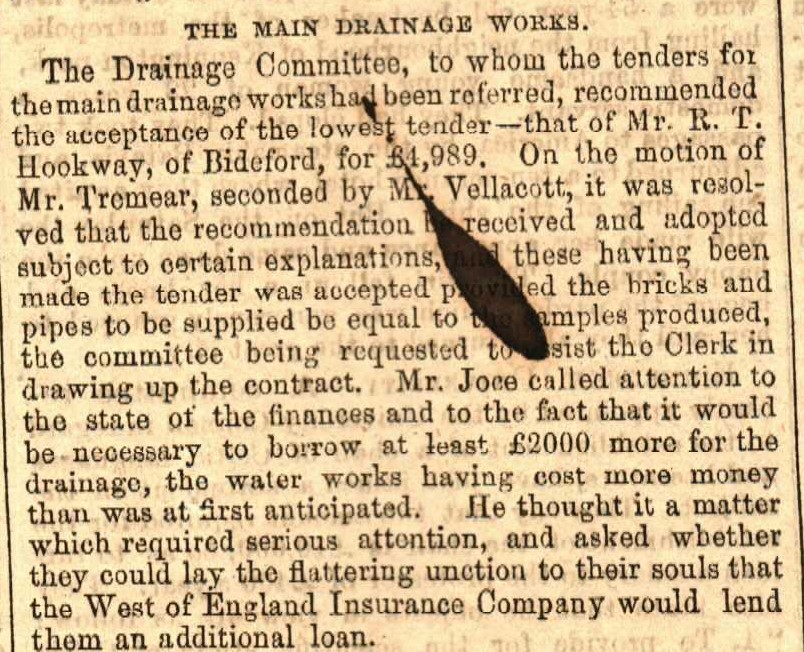
Bideford needed a drainage system to provide improved living conditions. Tenders were sought and the Drainage Committee from the Town Council opted for the lowest tender – Mr. R.T. Hookway at £4,989. Mr Joce, a councillor, wanted the council to borrow an extra £2000 as he said that the work would be more expensive.
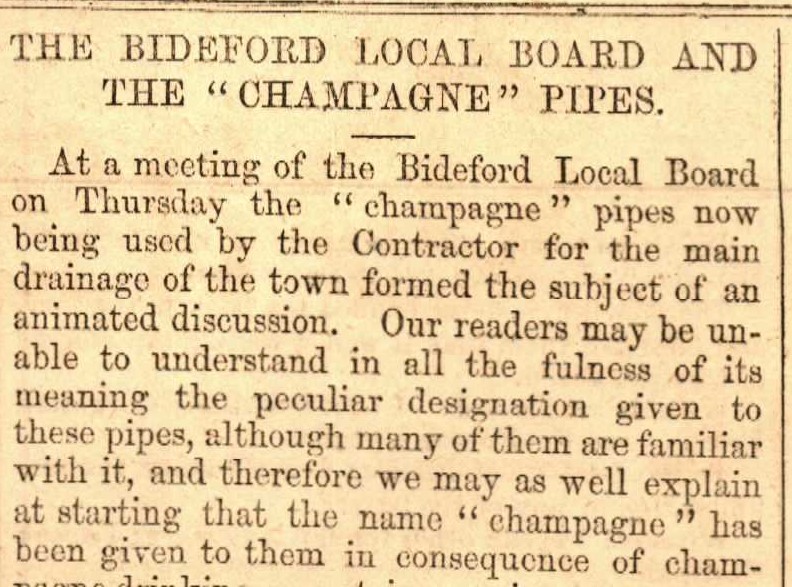
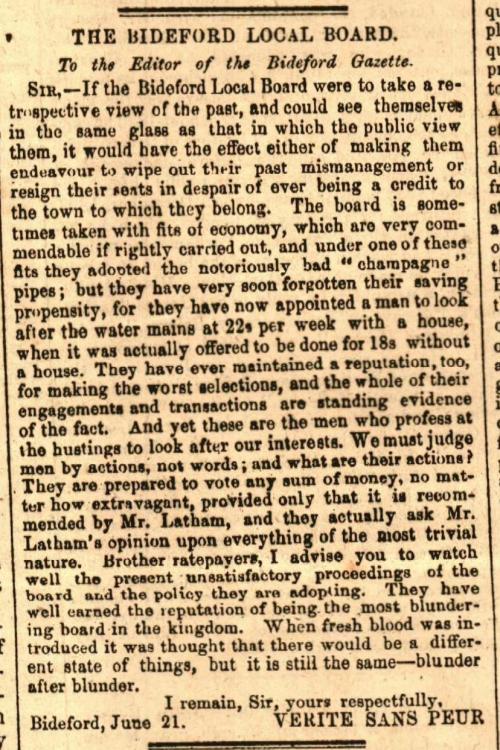
Mr Edward Risden was appointed as the Resident Engineer for the Drainage Works and Mr Baldwin Latham, C.E., was appointed at the Consulting Engineer. The pipes considered for the work were from Annery Kiln, North Devon Pottery and Branksea Pottery, Tamworth. It was decided to purchase the Tamworth pipes and the contract was signed before a letter arrived from Mr Latham advising the use of North Devon pipes. The cost of cancelling the contract was too great, thus the pipes from Tamworth were used despite much misgivings as to their quality. The North Devon pipes would have cost the same as the Tamworth pipes which were referred to locally as 'The Champagne Pipes.' The Surveyor was advised to reject all pipes that were inferior to the sample shown.
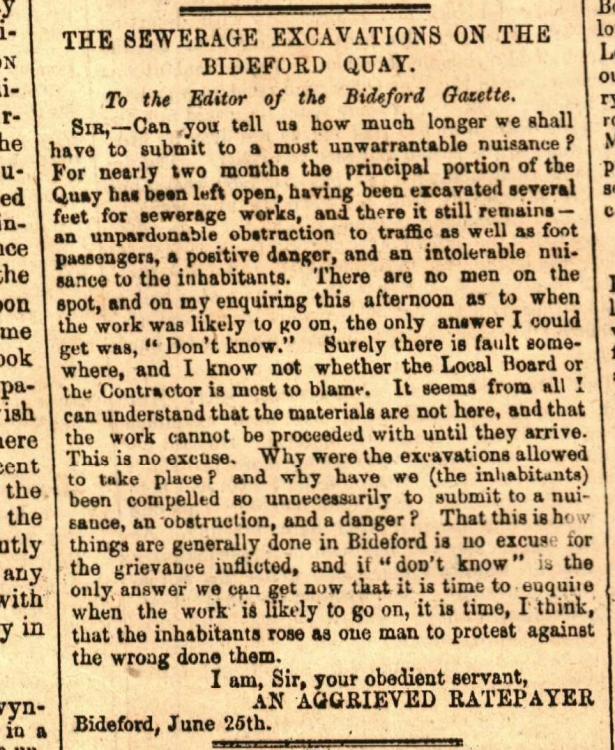
The disruption in the town due to the pipes caused some letters to the Editor.
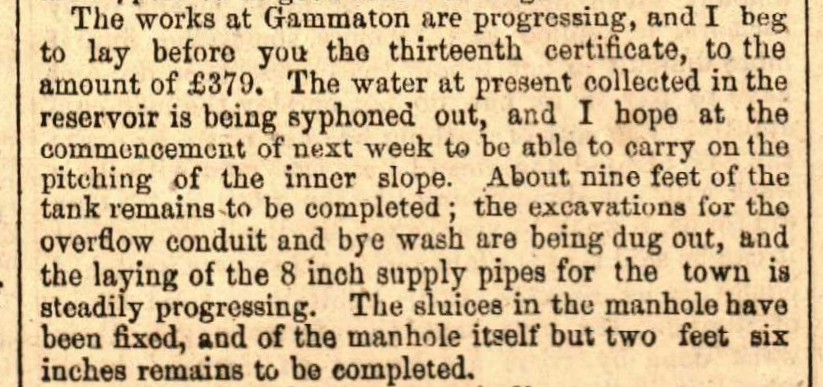
On the theme of water, it was reported in February that the 'water works have been at a standstill for several weeks in consequence of the frosty weather, and this delay has given considerable dissatisfaction to the consulting engineer, who is of the opinion that they ought to have progressed with greater speed before the frost set in. He now recommends the Local Board to push them on with all possible speed, and this recommendation will be adopted.' A few months later,
Gas supplies
Town gas was increasingly used for street lighting and home illumination and this period saw the proliferation of municipal and private gasworks, aided by the Gas and Water Works Facilities Act 1870 which allowed for the granting of Provisional Orders for these projects, often requiring the consent of local or road authorities. However, all was not well in Bideford.
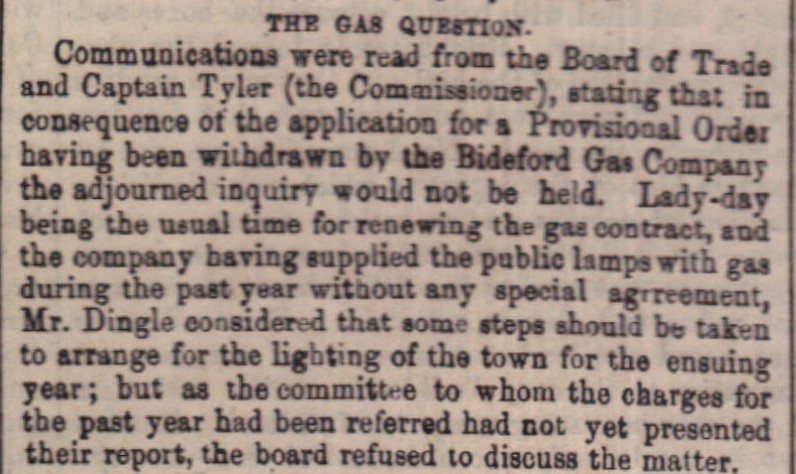
In February 1871 it was reported that 'a large number of signatures have been obtained to the memorial which is being got up with the object of preventing the Gas Company from obtaining their Provisional Order. The application will be opposed by the Town Council to the last extremity.' The next month, Captain Tyler, a Board of Trade Inspector, attended at the Town Hall, Bideford, to inquire into the objections raised by the Local Board and a large number of ratepayers against a Provisional Order being granted to the Gas Company, on the ground that such an order would be inimical to the interests of the gas consumers. The inquiry created a great deal of interest and the Town Hall was well filled. At the end, Captain Tyler intimated his intention of adjourning the inquiry and expressed hope that some amicable arrangement would be arrived at. During the inquiry the manifestation of feeling against the Gas Company was very marked, and Capt Tyler was frequently obliged to demand order. Later in the month ..
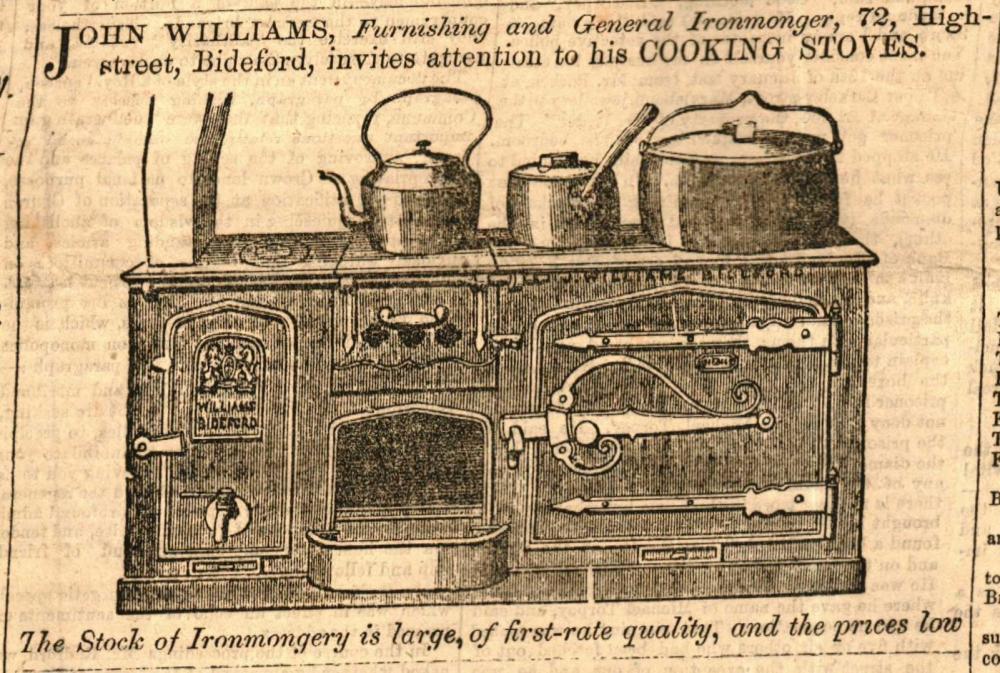
The Coal Stove to have in 1871.
In other news
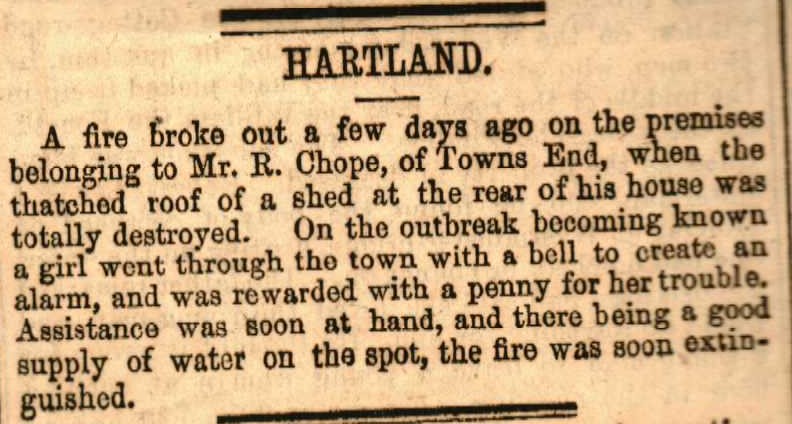
Hartland Fire
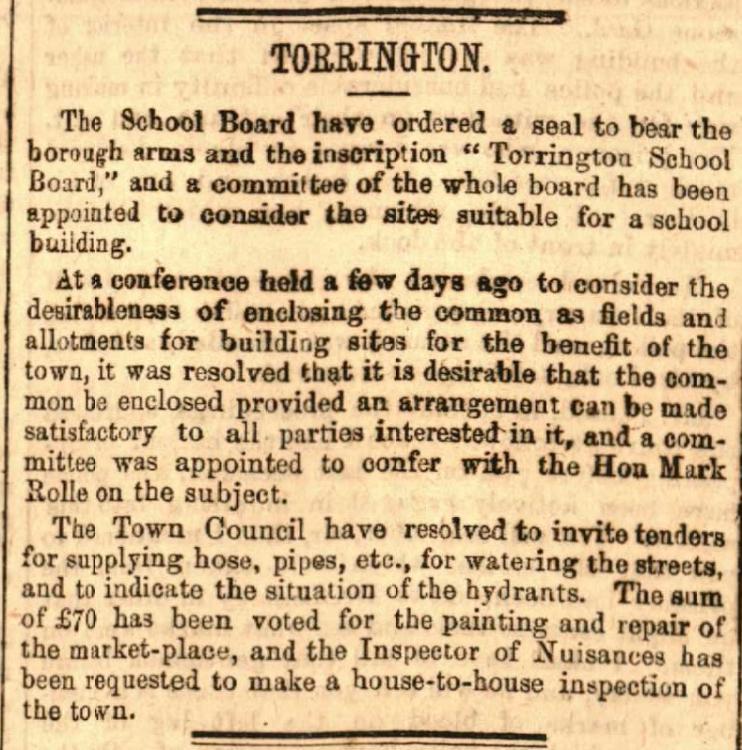
Hoses for Torrington
A Bideford and District article about the early origins of the fire brigade in Bideford can be found here -