Voluntary Firemen not comedy teams
Voluntary firemen not comedy teams Aug 1957
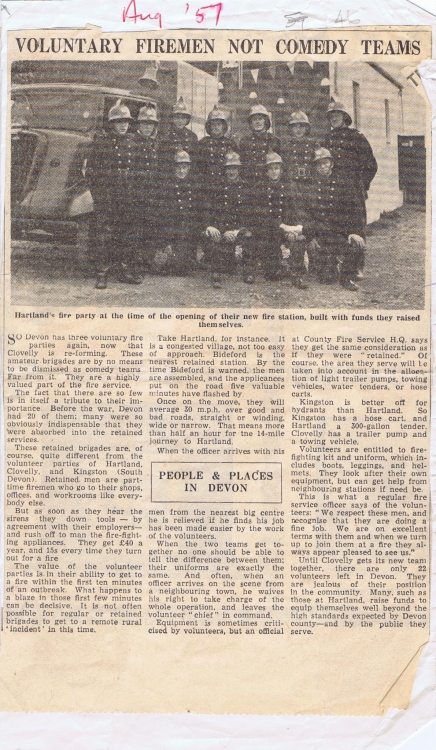
Hartland’s fire party at the time of the opening of their new fire station, built with funds they raised themselves.
So Devon has three voluntary fire parties again, now that Clovelly is re-forming. These amateur brigades are by no means to be dismissed as comedy teams far from it.
They are a highly valued part of the fire service.
The fact that there are so few is in itself a tribute to their importance. Before the war, Devon had 20 of them; many were so obviously
indispensable that they were absorbed into the retained services.
These retained brigades are, of course, quite different from the volunteer parties of Hartland, Clovelly, and Kingston (South Devon).
Retained me are part-time firemen who go to their shops, offices, and workrooms like everybody else.
But as soon as they hear the sirens they down tools – by agreement with their employers – and rush off to man the fire fighting appliances.
They get £40 a year and 15s every time they turn out for a fire.
The value of the volunteer parties is in their ability to get to a fire within the first ten minutes of an outbreak.
What happens to a blaze in those first few minutes can be decisive. It is not often possible for regular or retained brigades to get to a remote rural ‘incident'
in this time.
Take Hartland for instance. It is a congested village, not too easy of approach. Bideford is the nearest retained station. By the time Bideford is warned,
the men are assembled, and the appliances put on the road five valuable minutes have flashed by.
Once on the move, they will average 30 mph over good and bad road, straight or winding, wide or narrow. The means more than half an hour
for the 14 mile journey to Hartland.
When the officer arrives with his men from the nearest big centre he is relieved if he finds his job has been made easier by the work of the volunteers.
When the two teams get together no one should be able to tell the difference between them: their uniforms are exactly the same. And often,
when an officer arrives on the scene from a neighbouring town, he waives his right to take charge of the whole operation, and leaves the volunteer “chief” in command.
Equipment is sometimes criticised by volunteers, but an official at County Fire Service HQ says they get the same consideration as if they were “retained.”
Of course, the area they serve will be taken into account in the allocation of light trailer pumps, towing vehicles, water tenders, or hose carts.
Kingston is better of for hydrants than Hartland. So Kingston has a hose cart, and Hartland a 300 gallon tender. Clovelly has a trailer pump and a towing vehicle.
Volunteers are entitled to fire-fighting kit and uniform, which includes boots, leggings, and helmets. They look after their own equipment,
but can get help from neighbouring stations is need be.
This is what a regular fire service officer says of the volunteers: “We respect these men, and recognise that they are doing a fine job.
We are on excellent terms with them and when we turn up to join them at a fire they always appear pleased to see us.”
Until Clovelly gets its new team together, there are only 22 volunteers left in Devon. They are jealous of their position in the community.
Many, such as those at Hartland, raise funds to equip themselves well beyond the high standards expected by Devon county – and by the public they serve.