
Hartland Point Lighthouse
Designed by Sir James Douglass, construction began on Hartland lighthouse in November 1873 by contractor Mr Levi Yerward under the supervision of resident engineer Henry Norris.
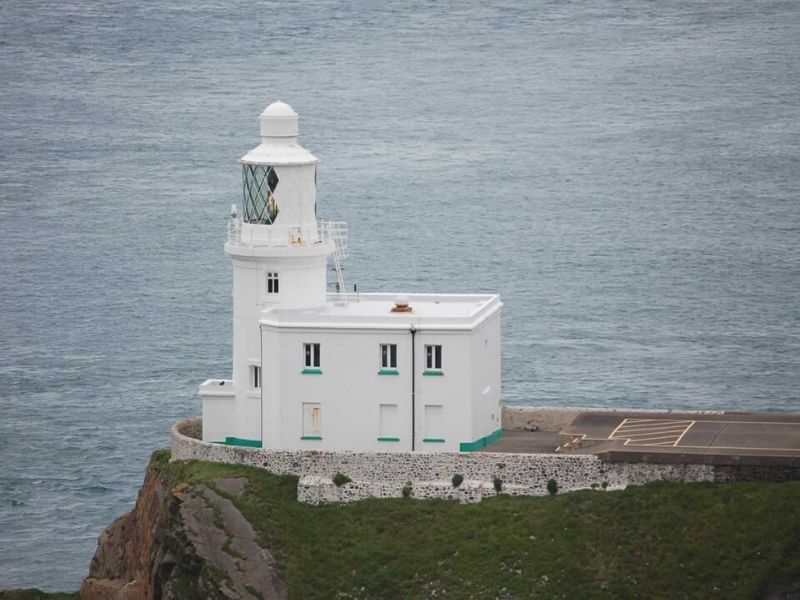
Photograph courtesy of Patrick Tubby
North Devon Gazette dated 21 June 1870 - 'A lighthouse is about to be erected near Hartland Point.'
North Devon Journal 23 June 1870 - 'Proposed new lighthouse at Hartland Point – The necessity of a lighthouse at Hartland Point has more than once being strongly urged, frequent wrecks occurring on that iron-bound coast. Sometime since negotiations were entered into for the purchase of piece of land for the construction of a lighthouse near Hartland Point. On Friday it is stated these negotiations were brought to a satisfactory termination, and it is reported that the work of constructing the lighthouse will shortly commence.'
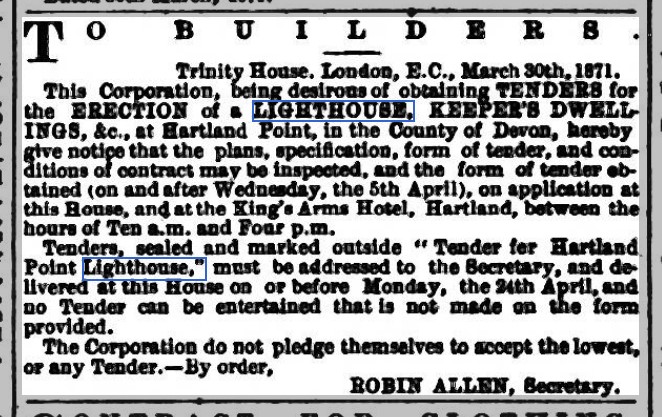
4 April 1871 - Western Morning News
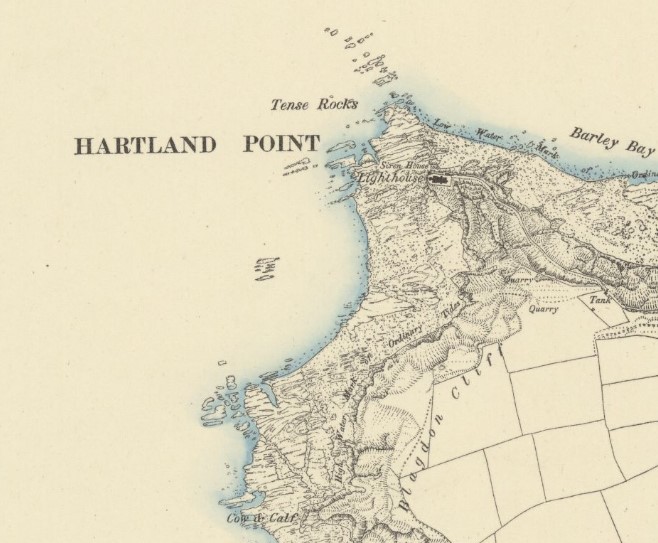
1885 Ordance Survey Map
From The Hartland Chronicle, July 1905, the following historical information is provided - 'The house is built upon a rock which formed a cone or needle beyond the Point itsself, and the road leading down to it is cut out of the face of the cliff. Mr Douglas (afterwards Sir James Douglas) was the engineer, but the road and the site of the Lighthouse, both of which were inaccessible were surveyed by Mr Beasley. The cutting of the road was begun in July 1871, but it was not until November 1872, that the chief foundation stone was laid under the tower doorway by Mr James Haynes of Blagdon, other stones being laid by his sister and brothers. The chief stone was hewn from the hard blue rock on the site, and in a cavity were inserted a sealed bottle containing the names of those who were present, some current newspapers and a few coins.'
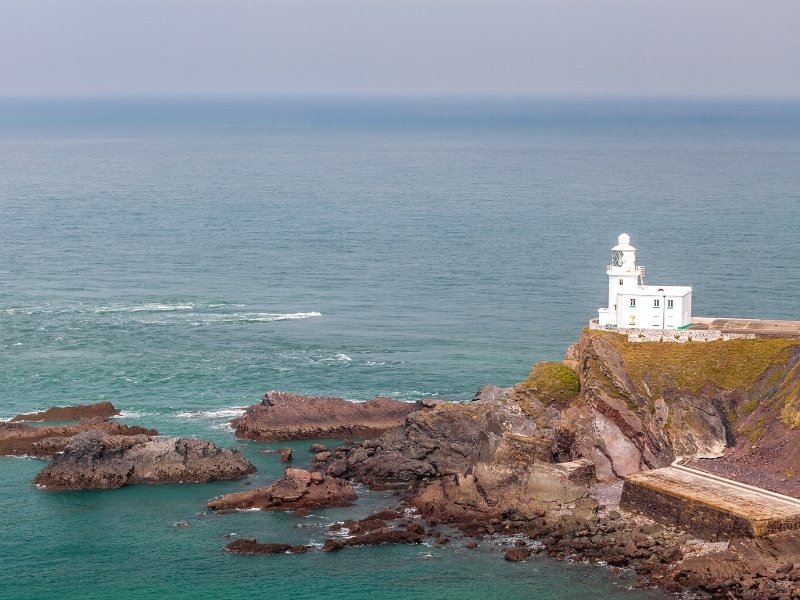
Photograph courtesy of Patrick Tubby
Western Morning News 28 July 1871 - 'A lighthouse for Hartland. An undertaking, which was projected certainly almost a century and a quarter ago, is at last on the eve of being carried into execution. In the Gentleman’s Magazine for 1755 it is mentioned that a proposal was then lately made to erect a lighthouse on Hartland Point by a gentleman remarkable for public spirit, who offered, if this proposal was complied with, to erect a mathematical school in Bideford, and endow it with £50 per annum. The lighthouse and the school failed to come into existence at the time. It is now announced, however, that Mr Levy Yerward, late Government contractor at Pembroke Dock, has been selected by the Trinity Board to erect a lighthouse, dwelling-houses, and other buildings at Hartland Point. As to the school, it may be assumed that all educational deficiencies in Bideford will be met and overcome by the School Board.'
North Devon Herald 30 October 1873 - “The New Lighthouse. Within a few months a beacon light will nightly shine forth to warn the mariner off the ironbound coast that stretches from Padstow to Bideford Bay. Many a noble ship running up the Bristol Channel has been dashed to pieces against the cliffs – in many places perpendicular for 300 or 400 feet – between Morwentstow and the jutting land at Hartland; and for centuries past this part of the coast has been dreaded by the storm-tossed navigator of the Bristol Channel. Under the shadow of Hartland Point lie the remains of a gallant ship, driven ashore last winter, and from this very Point the warning flame will shortly stream forth into the darkness and tempest. The light, which will be a broad steady one, will also be most valuable as an indication of the course to be steered. Frequently the light at Lundy Island is entirely obscured, and those at Bideford Bar are mistaken for others on the Welsh coast. This misunderstanding occasionally leads to disaster; and only a fortnight ago the schooner Tulip was from this cause wrecked on Saunton Sands, with the loss of three lives. Had a light been on Hartland Point it would have been almost impossible for a doubt to have existed as to the side of the Channel on which the vessel was. The lighthouse is so far complete that the lanterns are being placed in the tower, and it is expected that it will be opened in less than three months. Suitable appliances will be provided for the saving of life; and a telegraph wire will be ultimately laid on, in order that communication may be had with the lifeboat station at Clovelly. It is also probably that before a great lapse of time the scheme projected sometime since of laying a cable from Lundy to Hartland Point will be carried into effect, so as to telegraph to Bristol, Cardiff, and Swansea, the names of vessels going up or down Channel.”
The Western Morning News 28 November 1873 - 'The new lighthouse at Hartland will probably be illuminated next week. There will be one flash and two red lights.'
The North Devon Journal dated 25 December 1873 - 'The new lighthouse at Hartland Point is being proceeded with as rapidly as circumstances will permit. Its elevation is to be forty feet above high water-mark. The light exhibited is a first order revolving dioptric. It will revolve, shewing a flash every 30 seconds, over an arc of 242 degs., in the order of two white flashes and one red.'
From The Lighthouse Preservation Society
“Every lighthouse emits a distinctive series of flashes known as its ‘characteristic.’ These flash sequences allow ship captains to time intervals between flashes so that they can identify lighthouses, using a publication called the Light List. This publication assigns a number to each lighted beacon and describes its identifying characteristics. Flash sequences include the following: fixed, occulting, flashing, isophase, group flashing, alternating, and Morse code.”
Shipping and Mercantile Gazette 3 July 1874 - “This useful work, erected at the extremity of Hartland Point, was opened on Wednesday. The morning was wet and misty, but the weather cleared up at mid-day. The proceedings were commenced by Sir F Arrow, Deputy Master of the Trinity House, London, who in a short address alluded to the special necessity of a light at a point leading to the coal and iron districts of Wales and the Port of Bristol. The Bishop of Exeter invoked God’s blessing on the undertaking as a means of guarding the lives of our fellow countrymen and the Sailors of all nations. Sir Frederick Arrow, accompanied by as many of the company as could be conveniently accommodated, proceeded to the lantern, and requested Mrs Stucley, of Hartland-abbey, to light the lamp, which she did under the direction of Mr J N Douglas, after which the Bishop said a short but appropriate prayer. The company then proceeded to inspect the machinery connected with a fog-horn. It consists of an engine propelled by hot air, at 25lb pressure, blowing a horn for a key of seconds duration, at intervals of two minutes, which in foggy weather would be heard at sea for miles when the light cannot be seen. The Bishop, accompanied by his chaplains, proceeded to the rooms in the lighthouse, where a short service was performed and the lighthouse was opened. The lantern room being of limited size could not accommodate the whole of the company, and, after the opening, Captain Nisbet and Mr J M Douglas explained the machinery. The light, which may be seen for nearly 30 miles, is a revolving dioptric apparatus, giving two white flashes and one red flash at every 30 seconds. At a luncheon the Bishop proposed “The Health of Trinity House” coupling with the toast the name of Sir F Arrow, who responded.”
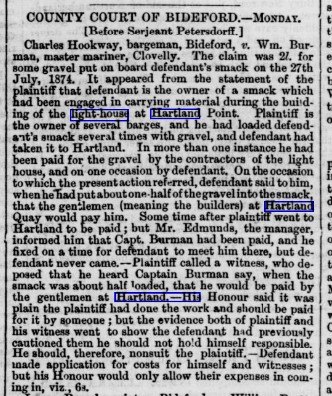
In August 1875, it is reported that Charles Hookway of Bideford, and William Burman of Clovelly, are in the County Court of Bideford.
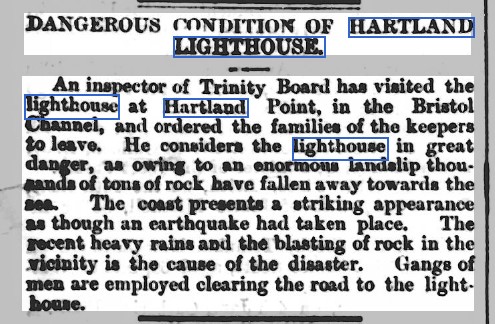
Western Gazette 19 January 1883 - “The lighthouse at Hartland Point, Bristol Channel, is unsafe, and the families of the keepers have been ordered to leave.”
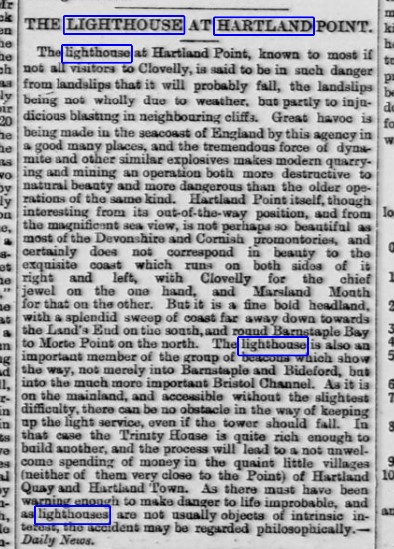
Fife Free Press - 20 January 1883
Western Daily Press - 23 January 1883
North Devon Journal 28 August 1884 - “Our correspondent “Marland” writes us the following:-“During a visit to Hartland lighthouse on Friday I witnessed with much pleasure the gambols of a pair of immense seals under the lighthouse, evidently enjoying the splendour of the midday sun. They kept close together. Their speed of movement was very great. The lighthouse keeper told me he had never seen more than one at a time before.”
Western Morning News 16 March 1893 - “At the annual meeting of the Penzance and Sennen branch of the Royal National Lifeboat Institution, Mr G F Tregelles, referring to the question of electric communication with lighthouses, remarked that they were aware from questions asked in Parliament that there had been great delay owing to lack of funds. Captain H T Reading (Trinity superintendent) in replay to a question, said he only knew of one lighthouse that had been connected, that at Hartland Point. The coastguard stations were connected.”
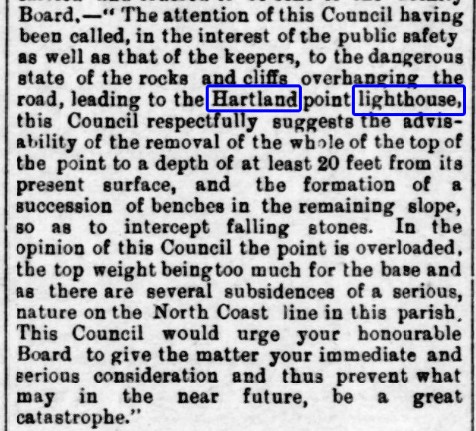
The question of safety was again raised in 1903 when it is reported that Hartland Parish Council will write to the Trinity Board:
"Mr Griffiths presided at the monthly meeting of the Hartland Parish Council on Thursday, other members present were Messrs Allin, Burrow, Heard, Harris, Jeffery and Walter. The following resolution was unanimously carried and ordered to be sent to the Trinity Board..."
In January 1911, Trinity House issued a notice to mariners, relative to the Bristol Channel, announcing that a red horn fog-signal has been substituted for the siren signal at Hartland Lighthouse. The character of the new signal is two blasts of 2¼sec. each in quick succession every 20sec, as follows: Blast 2¼, silence 2¼, blast 2¼, silence 13¼ sec.
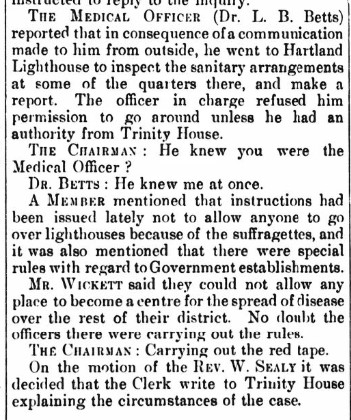
The Hartland and West Country Chronicle, Oct 11th, 1913, reports that the Medical Officer, Dr L B Betts, was refused access to the lighthouse.
May 1924 - At a Bideford Rural District Council meeting, intimation was received that it is now proposed to build the suggested Hartland coastguard cottages in a field to the west of Stoke church, and the Council was asked to consent to the division of a footpath on the site. It was decided to refer the application to Hartland Parish Council for its observations.
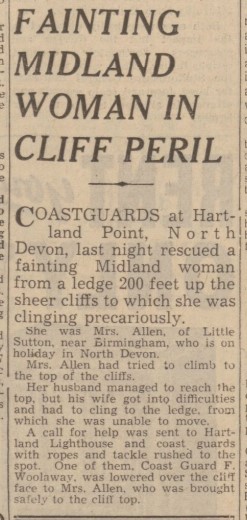
The coastguards, including F Woolaway, Mr Webb and Station Officer Shirley, make a cliff top rescue in August 1939:
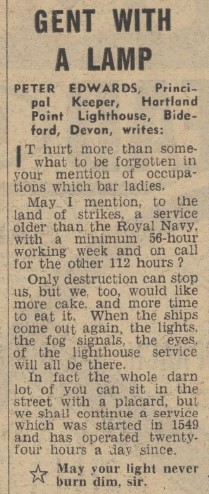
During the 1966 State of Emergency, Peter Edwards, Principal Keeper at Hartland Point Lighthouse, wrote to the Daily Mirror (dated 9 June):
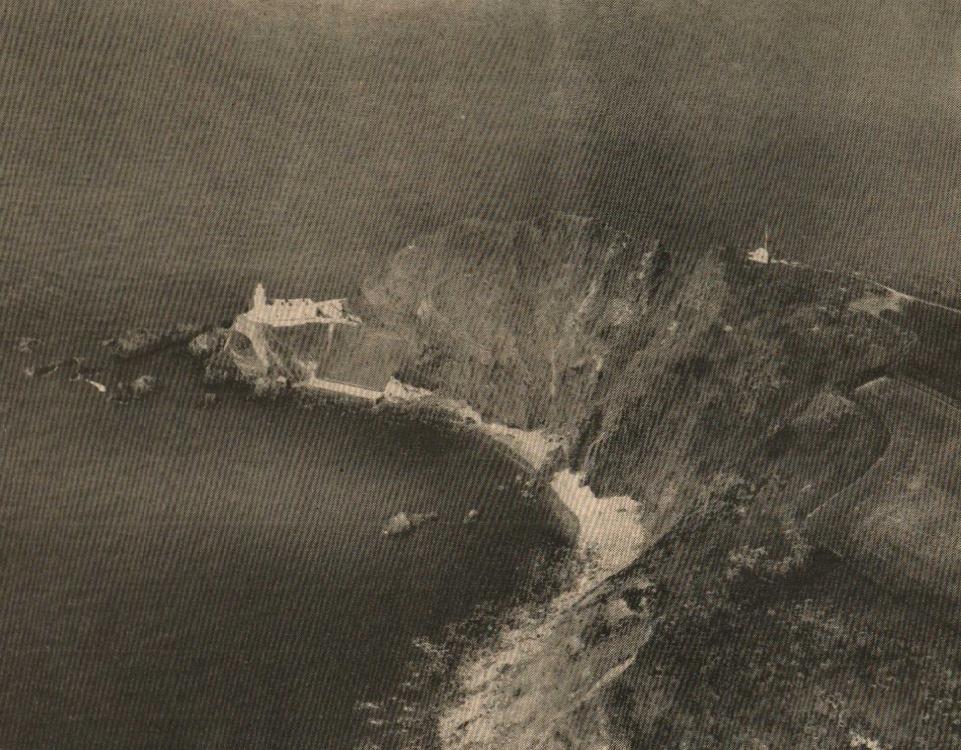
In the Bideford and North Devon Weekly Gazette dated September 28, 1973, the following article was published: “One hundred years ago this winter work on building the lighthouse at Hartland Point was in progress. The lighthouse, erected on a rock beyond the 350-foot high Point, represented a challenging piece of engineering, for the surveyor, unable to get anywhere near the site, was obliged to make his plans from observation and measurements taken from a ship at sea. Before work could begin on the actual erection of the lighthouse (a long advocated need on this hazardous coast) a road had to be cut along the cliff on the north side. This began in July 1871 and in November 1872 the chief foundation stone of the lighthouse was laid. The project was completed some 18 months later. Seaward its geographical range is 17 miles, but its light deflected by cloud formation has been seen up to about 80 miles.”
Census returns
1901 - Lighthouse Point – William Darling - Principal Lighthouse Keeper, Fanny Darling - wife; Alfred Bromley May, Lighthouse Keeper; William R Rowe, Lighthouse Keeper, Lilian E Rowe, wife.
1911 - Hartland Lighthouse - David Williams - Lighthouse Keeper, Isabel Williams, wife, Constance Williams, daughter, David Williams, son, Charles Williams, son, Jessie Isabel Williams, daughter; William James Slater, Lighthouse Keeper, Elizabeth Slater, wife; Thomas Henry Smith, Lightkeeper
In August 1916 it was reported that "in the Great Advance, Charles Williams (formerly of Hartland Point Lighthouse) was wounded Friday, June 29th, and his brother David killed on Monday, 3rd July."
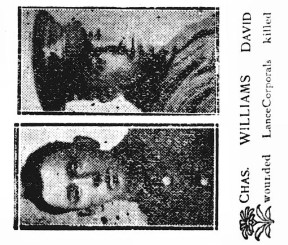
1921 Census – Hartland Point Lighthouse - John Cainan Clay, 47, lighthouse keeper, Trinity House, London - Julie Augustine (wife) and Julie Aurelie Fanny (daughter), 17 – Richard Roskruge, 26, lightkeeper, Trinity House – Ophelia (wife) and Nellie Argo (adopted daughter) 15
It was reported in December 1933 that “On Sunday, December 3rd, Mr Lionel Scott Phillips (who was a keeper there from 1905 to March, 1908) died. His wife Constance is the only daughter of the late Alfred Bromley May, also light-keeper here more than twenty years before he left in August, 1903. Mrs May (nee Annie Buckler, of Hartland, lives with Mrs Phillips.” In February 1946 "Walter Henry Warder, a keeper of many years ago of Hartland lighthouse, has lately died at the age of 102." Mr Warder was principal at Hartland 1895-9.
1939 Register – The Lighthouse - Jack Maybourn, Lighthouse Keeper - Annie Maybourn (wife); Frederick W Webb, Lighthouse Principal – Alice M M Webb (wife) - Doris M Webb - Thomas G Davies, Supernumerary Assistant Keeper; George Prebble, Lighthouse Keeper - Winifred A Prebble (wife)
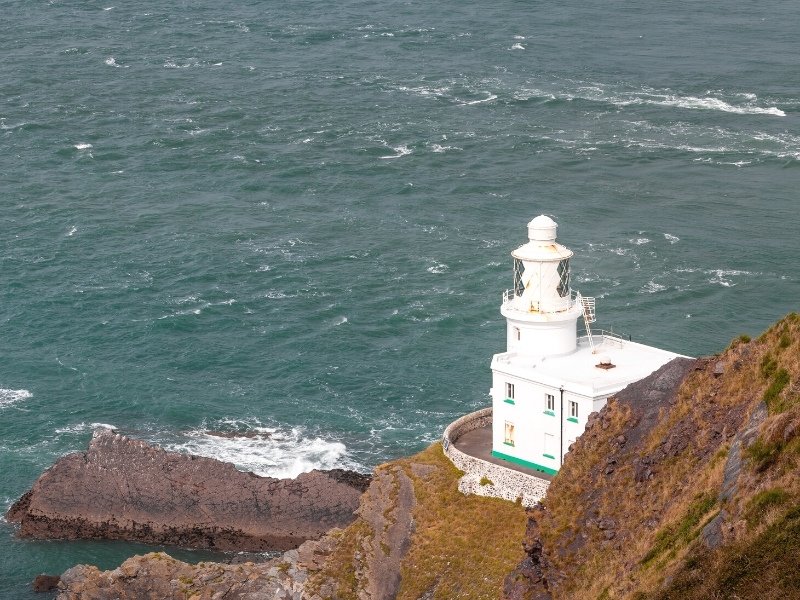
Photograph courtesy of Patrick Tubby
In February 1946, the death of Walter Henry Warder was announced: 'a keeper many years ago of Hartland lighthouse, has lately died in Leeds at the age of 102 years.'
Trinity House
Founded in 1514 by royal charter, The Corporation of Trinity House of Deptford Strond is also known as Trinity House (and formally as The Master, Wardens and Assistants of the Guild Fraternity or Brotherhood of the most glorious and undivided Trinity and of St Clement in the Parish of Deptford Strond in the County of Kent). It is the official authority for lighthouses in England, Wales, the Channel Islands and Gibraltar and its responsibilities incorporates the provision and maintenance of other navigational aids, such as lightvessels, buoys, and maritime radio/satellite communication systems. It is an official deep sea pilotage authority, providing expert navigators for ships trading in Northern European waters.
Funding for the work of the lighthouse service comes from "light dues" levied on commercial vessels calling at ports in the British Isles, based on the net registered tonnage of the vessel. The rate is set by the Department for Transport, and annually reviewed. Funding for the maritime charity is generated separately.
Trinity House is also a maritime charity, disbursing funds for the welfare of retired seamen, the training of young cadets and the promotion of safety at sea.
Sir James Nicholas Douglass – Trinity House’s Engineer-in-Chief - was born in London 16 October 1826 and was the eldest of the two sons of Nicholas Douglass, also a civil engineer. He joined Trinity House after serving an apprenticeship with the Hunter and English company. With his brother William, he worked as an assistant to his father during the construction of the Bishop Rock lighthouse in the Scilly Isles. After a brief period working for the Newcastle carriage builders R J & R Laycock, he returned in 1854 to assist in the lighthouse's final completion and to marry Mary Tregarthen. Trinity House then engaged him as Resident Engineer to design the Smalls Lighthouse off the coast of Pembrokeshire, his first solo project. Other projects in which he was involved included Dondra Head Lighthouse in Sri Lanka, Longships Lighthouse off Land’s End in Cornwall, Old Lower Lighthouse, Isle of Portland, and Smalls Lighthouse, off Pembrokeshire. On completion of the fourth Eddystone lighthouse he was knighted on 29 June 1882 and died on 19 June1898 at his home on the Isle of Wight.
Henry Norris was a British civil engineer born in Poplar, London, 1816, the son of several generations of house carpenters. He was the resident engineer for lighthouse construction projects under contract to Trinity House from civil engineers Messrs. Walker & Burges, the firm of James Walker and Alfred Burges, and later on oversaw the building of Souter Lighthouse, the world's first lighthouse specifically designed & built to be powered by electricity. He died at Stratford, London, in 1878 and is buried at Tower Hamlets Cemetery. His grave was located during ground clearing work in 2013.
From Trinity House website:
Height of light above Mean High Water 30m
Automated 1984
Electrified 1927
Character Fl (6) 15s
Intensity 635 candela
Range of light 8 NM
Region West
Wikepedia
Decommissioned in 2012
Marketed and sold at a £450,000 guide price in 2015
2022 – the lighthouse lantern, estimated at more than £1m, was stolen from Ilfracombe during restoration work. A reward was offered for its return.
Credits - Trinity House; Wikepedia; The Lighthouse Preservation Society; National Library of Scotland; Find My Past; lighthouseaccommodation.co.uk;