
The Importance of the Smaller Towns
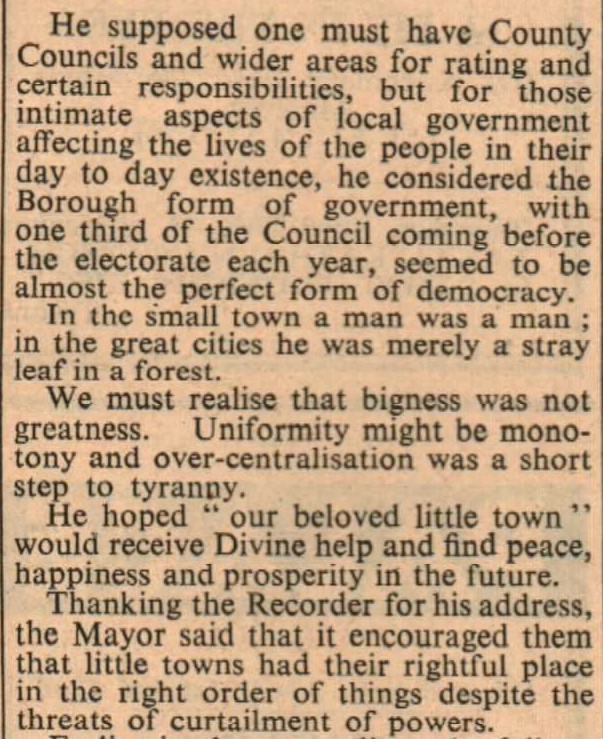
Addressing this year’s Manor Court ceremony at Bideford, the Recorder of Bideford, Mr W B Faraday, spoke of the important contribution made to the nation by small boroughs and, referring to the possibility of Bideford, with other similar towns, losing the privilege of Quarter Sessions, said it seemed to him a queer reason to take such a privilege away from a place simply because it was well behaved and there were few cases.
Introducing the Recorder, the Mayor of Bideford, Cllr A K Chope, said the Justices of Peace Act would have the effect of bringing to an end their local Borough Bench and Quarter Sessions, but loopholes had been left in the Act by which they hoped that towns like Bideford and Barnstaple would retain these offices. It happened that that day was the last upon which any such appeal could be made. Bideford’s appeal had been made some time ago.
The Recorder spoke of the concern felt for the problems arising from the spread of great cities.
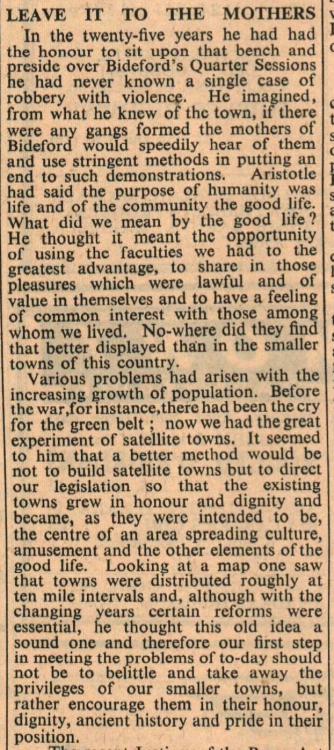
The recent Justices of the Peace Act seemed to him, until it was amended, to be going rather astray. Stress was laid on the big cities instead upon the more widely distributed smaller towns. It was quite true that at Bideford they had a smaller percentage of crimes at Quarter Sessions per head of population then would be found at, say, West Ham or Liverpol, but it seemed queer reasoning to him to take away a privilege from a place because it was extraordinarily well behaved.
Earlier in the proceedings the following had been empanelled as a jury: Messrs C J Smith, F Sanguine, W H Luxton, J T M Mitchell, J Bale, H M Heywood, L H Gorrell, R B Blackmore, J H Lowther, C Morris, E Sawtell and F W Beer. Mr C J Smith was chosen foreman.
The Recorder spoke to the gathering while the jury were out of the room considering what presentments they wished to make. They had heard the Steward of the Manor, Mr F C Backway, report on the action taken by the Lords of the Manor, the Town Council, on presentments last year.
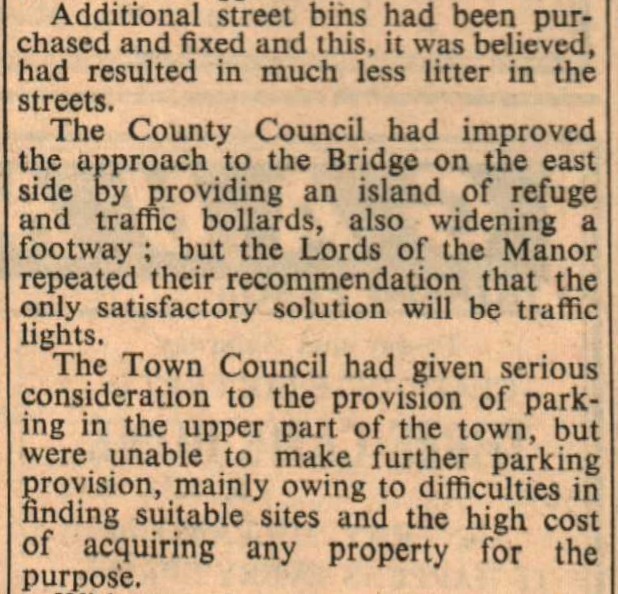
With regard to the piece of land containing shrubs outside the Art School, the ownership of the school had been the subject of a dispute but the Minister of Education had now decided it had been passed to Devon County Council. The Borough Council had accepted responsibility for the portion of land referred to and had appointed a sub-committee to consider suggestions as to its future.
On their return the jury submitted the following names for appointments:
People’s warden at St Mary’s Church – Mr F C Backway
The jury, to whom a representation from the Parochial Church Council had earlier been passed, regretted that Mr C E Tucker, after fourteen years’ service as Churchwarden, felt he could not take office again. They expressed their thanks to him for his service, which the Lords of the Manor appreciatively endorsed.
Tythingman – Mr S Braund; Waywardens – Mr R Cook and Mr W Dennis.
The Lords of the Manor confirmed the appointments which were accepted by the individuals concerned.
Further presentments by the Jury were:-
- They considered the Kingsley Statue was in a disgraceful condition. They urged that it should be cleaned, the surrounds replaced, also the wreath.
- They felt that work on the ground outside the Art School should be hurried as the holiday season would shortly be opening. They considered this, too, a disgrace at present.
- The Lords of the Manor as the Town Council were asked to press the County roads department to improve roads and paths, some of which were in a very bad condition.
- The Jury considered that more notices announcing free parking on the Pill should be displayed for the benefit of visitors.
- They considered a ‘Keep Left’ sign should be placed at the junction of High Street and Pitt Lane, also at the bottom of Bridgeland Street.
- The suggestion that there should be traffic lights at the east end of the Bridge was renewed. It was also considered that the bus stop should be moved a few yards back along Barnstaple Street to give a better view of the corner to road users.
The Mayor said the points would be considered by the Lords of the Manor as the Town Council. He thanked the Jury for their services and welcomed visitors who had watched the ceremony.
When he responded to the toast of “The Manor, Port and Trade of Bideford” at the luncheon at Tanton’s Hotel, Bideford, after the ceremony and over which he presided, the Mayor, Cllr A K Chope, took the opportunity of referring to the oft-heard subject of a public hall for the borough. They would remember that at the last Mayor-choosing ceremony he had said he did not see why during the next twelve months they should not at least explore the possibility of such a hall and possibly get out the plans. Since then they had not heard a word about it and probably thought the matter had been dropped, but he had made a few inquiries.
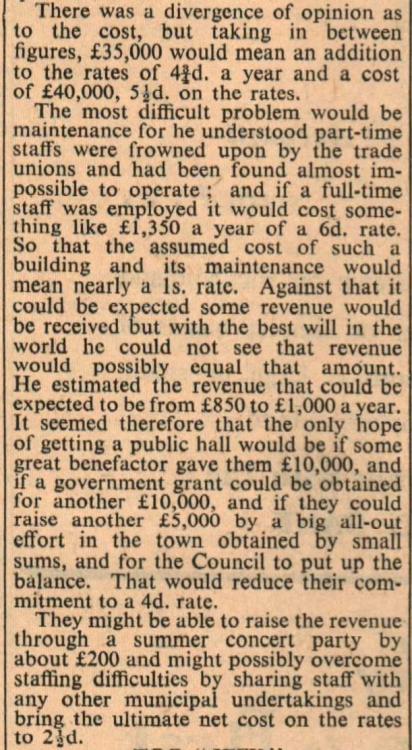
“But, in my opinion, it is too ‘iffy’ and I am afraid I am not prepared to back such an ‘iffy’ proposal,” continued his Worship. “We hope that times will get better and then we can think about it, but the present seems a bad time – rates are high and possibly going higher and I gather there is a definite limit to the amount of money that is available for entertainment purposes.”
To those people who were always saying Bideford ought to have a hall he had asked how often they were prepared to use it and the general reply was a week, a year, or even once a year and that was not sufficient, even if multiplied twenty times. A hall of sufficient dignity and size for the borough therefore seemed to be a luxury which they could not afford at the moment and would have to await an era of prosperity.
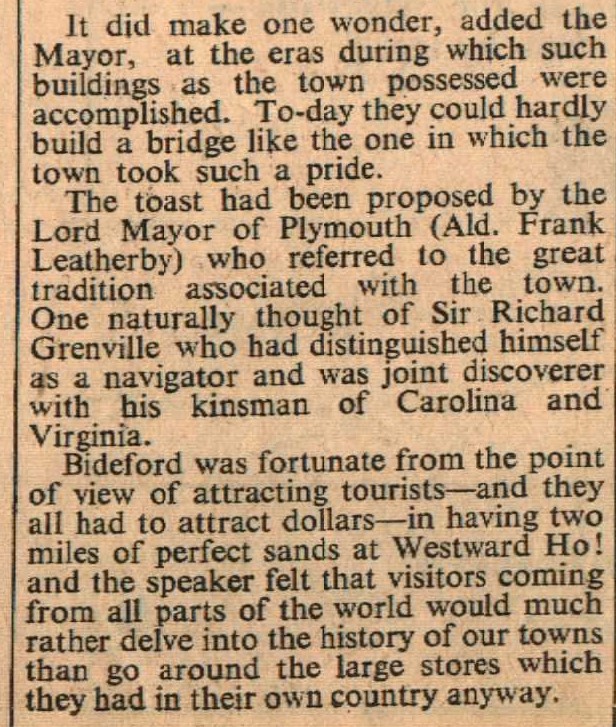
It was of great importance, thought the Bishop of Exeter, Dr R C Mortimer, who was among those responding, that such ancient traditions as the Manor Court ceremony, which so closely bound municipal and religious life, should be maintained. The healthy activity and condition of cooperative friendliness in municipal life depended almost entirely upon the spirit in which those who tool part in that life entered into it, and that spirit was inspired by and derived from religion primarily.
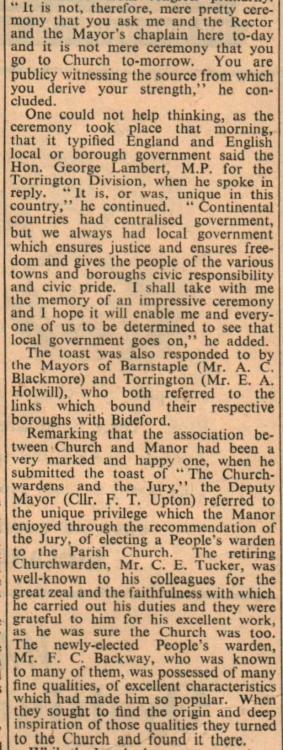
The toast was responded to by the newly-elected People’s warden, Mr F C Backway, and by Mr C J Smith, foreman of the Jury.
Mr Backway added his tribute to the work of Mr Tucker and others who had preceded him in office and spoke of the excellent work of Mr W J Jenkins as Rector’s warden and of Mr K F Sollis as the unofficial Churchwarden of the Chapel of Ease at East-the-Water.
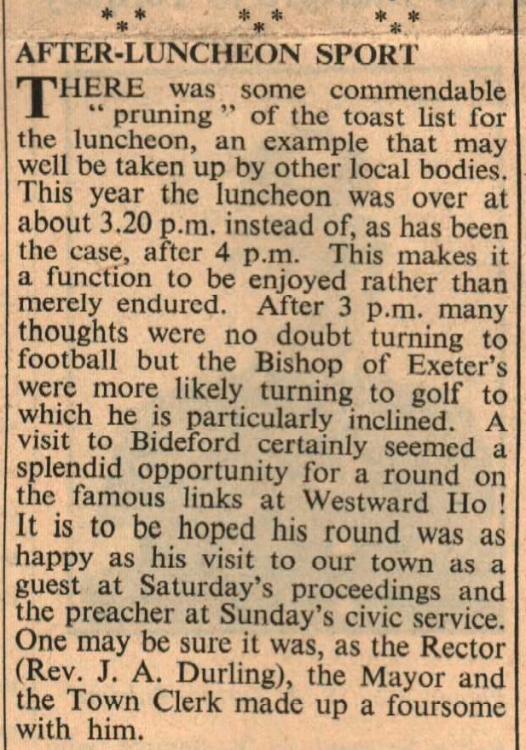
It was mentioned at the luncheon that to Cllr Mrs M Cox had fallen the distinction of being the first woman to attend the Manor Court luncheon as one of the Lords of the Manor.