
Commerating a Golden Jubilee
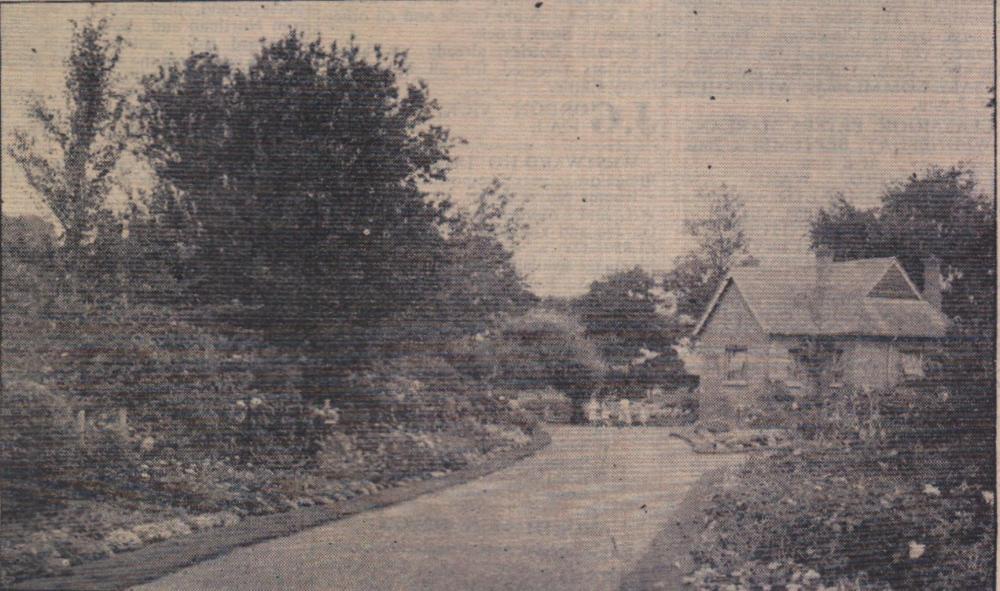
Bideford's Park is a favourite spot for Bidefordians who are pleased to hear that visitors admire it. The flower beds are invariably a mass of bloom throughout the spring, summer and autumn season at at once catch the eye. But read on to find out how the Park came into existence.
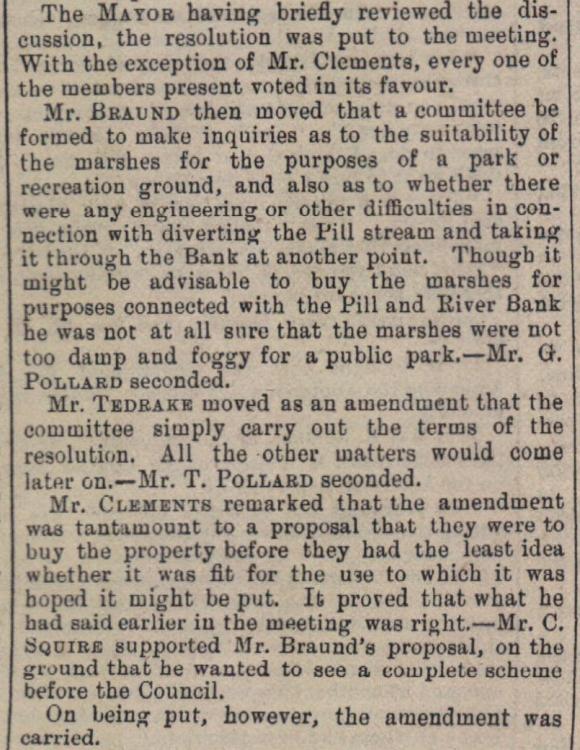
In September 1886 at a meeting of Bideford Town Council, the "first business was to receive the report of the Committee respecting the suggested purchase of the marshes adjoining the Pill. The report was to the effect that the Committee were of opinion that it was desirable to open up negotiation with Major Hogg and Captain Molesworth to inquire if they would sell, for public purposes their respective marshes, or such portions as might be agreed upon. The Committee also recommended that nothing be at present done to the flood-hatch, but the Surveyor watch it."
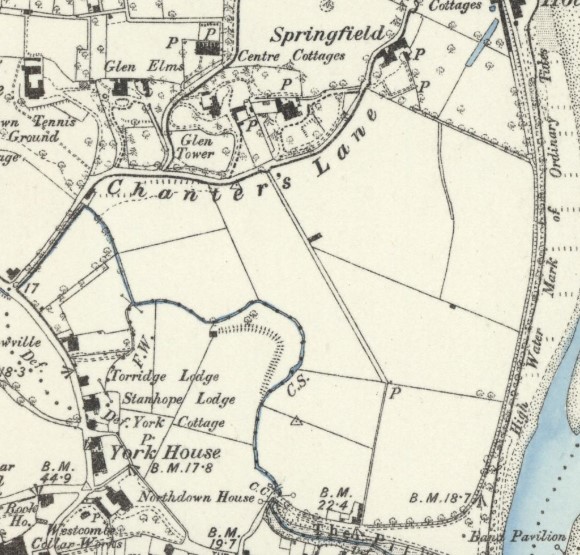
1886 Map
Queen Victoria was crowned in 1837, and in 1887 councillors decided to take steps to commemorate her Golden Jubilee - this provided the Council with a purpose. Ezekiel Rouse (the town doctor) proposed a recreation ground and Robert Dymond suggested the area known as the marshes. Councillor William Braund drew attention to the rumour that Northam was trying to ‘get hold of’ the foreshore adjacent to the marshes, so it was unanimously agreed that Bideford should take immediate steps to gain possession. It seems to have been unusual for all councillors to be in agreement……though not so rare for there to be conflict with Northam!
Ezekiel Rouse was born in 1841, brought up at Morwenstow, and was a general practicioner MRCS. In the 1891 Census he is shown as living at 11 Bridgeland Street with his wife, Margaret (nee Lloyd Ludlow), and 2 daughters, Barbara and Dorothy. Exekiel died 9 February 1898 and is buried at East-the-Water Cemetery.
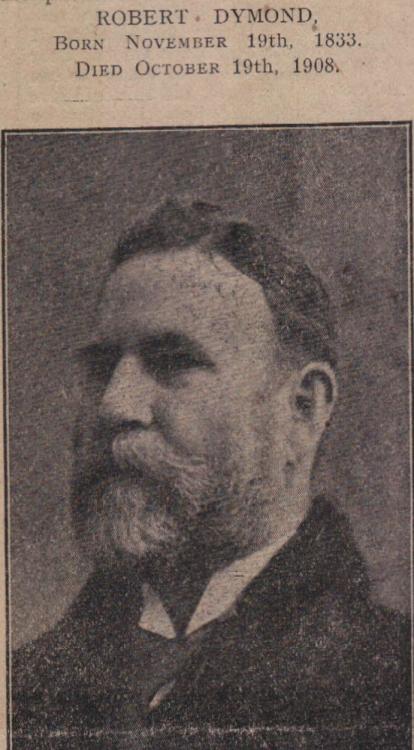
Robert Dymond, born in 1833 at Beaford, joined the Royal Marines and retired as a sergeant. He married twice and the 1891 Census details him as living at 55 and 56 Mill Street. In the 1901 Census details, he is living with Eliza at The Mount, North Down Road, Bideford - he is shown as 'auctioneer, estate agent, carriage proprietor'. He died 19 October 1908.
“A People’s Park in Prospective.
The Mayor (by permission of the Council) at once brought forward the question of the purchase of the two marshes adjoining the River Bank, at present the property of Major Hogg. The matter was one that had been before the public for some years, and was of great public interest. He was sure all present only wanted to do what was best for the town. They all regarded the River Bank as the lungs of Bideford, and anything they could do to improve that beautiful walk would be for the good of the neighbourhood. There were many reasons why the question of purchasing the marshes should be considered.” (1890 article)
It was reported on 11 March 1890, that "At a Special Meeting of the Bideford Town Council...The Mayor stated that the meeting was called to receive the report of the Committee appointed to inquire as to the possibility of purchasing the two marshes adjioning the River Bank. On behalf of the Committee he had to report that they had interviewed Mr Groves Cooper, the agent for Major Hogg, who was the owner of the marshes in question. On the following day a letter was received from Mr Cooper stating that he had seen Major Hogg and that the gentleman was prepared to sell the two marshes to the Town Council for £2,000, which was the amount named when the subject was discussed some years ago, the sale to be subject to the usual terms of contract."
Major Hogg agreed to sell the marshes. This was the lower half of the town’s current landholding, nearest to the town. They received permission from the Local Government Board to borrow money to buy and fence the land and the following year the purchase was completed, with a £2500 loan from the Prudential.
In the North Devon Gazette, 9 February 1897, Councillor Tucker "gave notice of motion that the Council consider the advisability of securing the marsh adjoining those now in their possession. He hoped the time would come when they should possess all the marshes, and lay them out. If they had Mr Pitt Fox's marsh, that would take them to Chanter's Lane. One of his thoughts was that the Council should buy the remainder of the marshes in this, the sixtieth year of Her Majesty's reign, and call it the 'Victoria Park.' That would be a good way of celebrating the Queen's Diamond Jubilee."
There was not much progress for a few years after that. There was talk of landscaping and planting trees but the council were working on projects which had to take priority - such as the construction of the technical school; dealing with the Pill stream and making the roadway; repairs to the riverbank; and improving the town’s water supply. The land was still wet although the cricket club did have the use of part of it, in spite of legal challenges (the Local Government Board said that as it had been purchased as a peoples’ park, the public could not be excluded). Plans for landscaping the park were drawn up by Mr Meyer of Veitch & Son of Exeter and over the next few years the council arranged drainage, added topsoil and sought tenders for planting of trees and shrubs. Queen Victoria died in 1901 and the park had still not been finished, the committee (described as ‘most lethargic’) needing a further £350.
The Mayor wrote to Northam asking for their co-operation, because the park although owned by Bideford was still within Northam’s jurisdiction. Bideford took the view that if they were to develop the marshes and riverbank it was essential that control should be in their hands by right not by courtesy. Northam’s response was reported to be that “Bideford had tried to steal the land once and now it was in Northam parish they intended to keep it”. This led to some administrative problems. As an example, the parkkeeper got into an argument with a dog-owner whose pet was pulling up flowers he had just planted – but there was no bye-law preventing it. For some years Northam declined to take any action, but eventually allowed Bideford to bring in their own restrictions.
An article dated 20 August 1907 states "Northam Council and The Pill. The Town Clerk reported the receipt of a reply from Northam Urban District Council to his inquiry whether that body would now offer no objection to Bideford making by-laws for Victoria Park and The Pill, and withdraw their claim to the Pill Land. in their reply Northam Council pointed out that in March, 1904, they had no objection to Bideford making by-laws for the park, but they could not now consent to comply with Bideford Council's request in regard to the Pill, and suggested that further consideration of the matter be deferred until the question of throwing open the road from Dorchester-terrace to the Pill was finally settled. Alderman Dymond said the reply was not so satisfactory as he had expected."
In 1912 it was reported that Northam Council was "willing to place the portion of the Pill land belonging to them under the control of the Bideford Urban District Council until further notice, thus enabling them to make the proposed bye-laws, subject to all receipts going to the Bideford and District Hospital, as from "Bideford and Northam Pill land receipts," or in such manner as the two Councils might agree, the accounts to be presented annually." It was not until 1934 that the boundary was changed, putting the park into Bideford.
Overall by the early 1900s the park was seen as a success. It had been built up with materials like road scrapings (and the deposit of rubbish continued until beyond 1904) yet in spite of the difficulties it had turned out to be a pretty spot. Some shrubs had been donated by local people so it had been done with an eye to economy as well as results. There were however still some issues, in particular balancing the interests of those who enjoyed tranquillity with others such as footballers. Mr Dymond suggested acquiring the neighbouring marsh for sports, a request repeated by Mr S.R.Chope a couple of years later. The “Bideford Park Rangers” liked the pitch in the park and were well supported with several thousand supporters on occasion, though they were restricted by the council’s refusal to allow them to erect regulation goal posts. They were also not allowed to collect money from supporters watching the games so they really needed a field of their own. Cyclists meanwhile had a dedicated track but cycling on Sundays was a bone of contention, with the council changing their policy more than once!
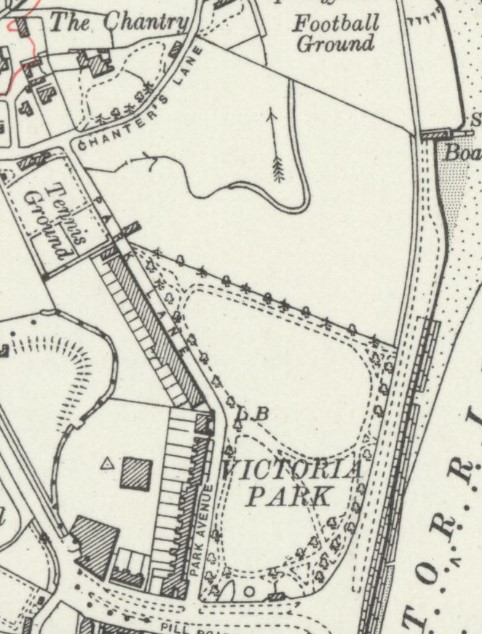
1935 Map
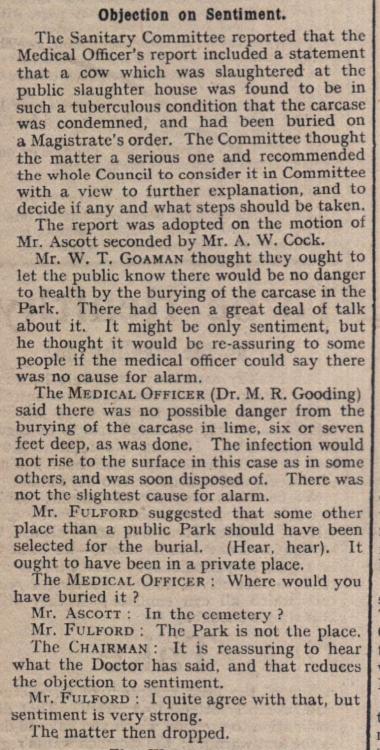
In 1908, there was the curious incident of the dead cow which was slaughtered due to TB and then buried somewhere in the park, apparently on the order of a magistrate. The council were annoyed about this, though it was a source of amusement to others! Jokes in an entertainment programme included "What's the difference between the Isle of Wight and Bideford Park?" - "At the Isle of Wight you have Cowes on top, and in Bideford Park, you have cows under it." "Why is Bideford Quarry like a diamond mine?" - "Because it contains stones, rare and precious."
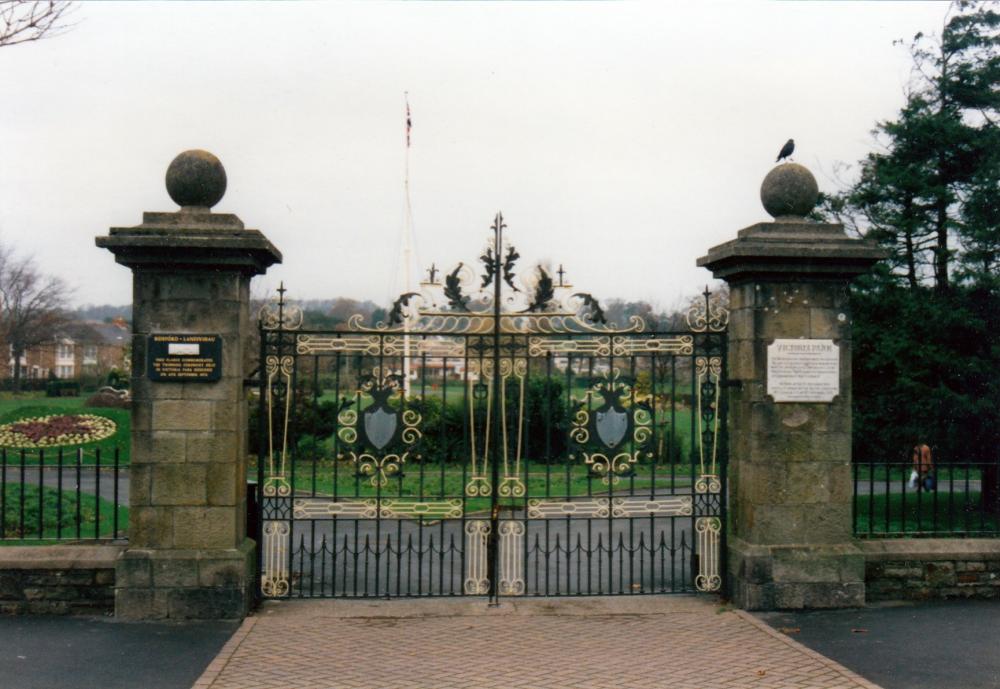
The gates were added in 1912, with construction of the main entrance funded by a dontation of £100 by Mr Peard, a local solicitor. A presentation shelter and clock were added to the park in his memory as he, like his wife, had died - his wife had been sister to Ezekiel Rouse, who first proposed a park. By this time King Edward VII had reigned and died, and George V was on the throne. A newspaper article dated 12 November 1912, states "The main gates of this Park were presented by the late George Oliver Peard, Esq., in memory of his wife, the smaller gates and railings being erected by the Town Council to commemorate the Coronation of King George V. The Park, after its enclosure, was formally opened by the Mayor, Councillor W T Goaman, J.P., on the 9th November, 1912.
In the 1911 Census, George Oliver Peard (born in Barnstaple) is living with his wife, Louisa Marion, at Riverside, Orchard Hill, and he is a 'solicitor' - his firm was Hole, Peard and Seldon. Louisa was buried on 4 July 1911 at St Margaret's Church, Northam. George died in 1912
No donor came forward to fund the construction of the bandstand so the council built up the area around the flagpole in 1912 and the cannons were moved, after being on display outside the technical School/Arts centre.
There was some further conflict in 1922 when Northam gave permission for building the houses in the lower half of Park Lane, right up to the landowner’s boundary. They did not however make any provision for a footpath or road, instead asking Bideford to donate the necessary land! Some councillors were opposed to this, feeling that Northam had put themselves into this position and should sort out their own problems, not look to Bideford to bail them out. Nevertheless a section of the park was made available for this purpose.
In 1944 an oak tree was planted to celebrate the good relations between the people of Bideford and US Army personnel who were stationed in the town between 1940-1944.
In 1937 the council applied for a grant from the King George’s Fields Foundation. They had recently purchased additional land to facilitate the long-awaited extension for sports, and the grant was for new gates and further site improvements. This was opposed by the Chamber of Trade who thought it was an extravagance (the land cost £6k) to prevent the site being developed for housing. Later still, in 1946, formal plans were drawn up for a multi-use park with a public hall, indoor and outdoor restaurants, ponds, swimming pool and various sports pitches. Meanwhile lorries were delivering refuse to the upper fields. Two men were employed to remove the topsoil, deposit the waste and then cover it again. This was seen as a practical solution to the problem of low-lying marshland - buying in and transporting stone to build it up would have been far too expensive and as they were sending 40 tons per week to the town dump, this seemed the best solution. The scheme was approved by the Ministry of Health and monitored by the borough surveyor. These playing fields were eventually completed after the war thanks to the grant of £2k from the King George Jubilee Trust with the project completed in 1951, and the Park Lane gates were installed with the approved plaques. This was a time of great optimism when even the new sewage screening building was attractive.
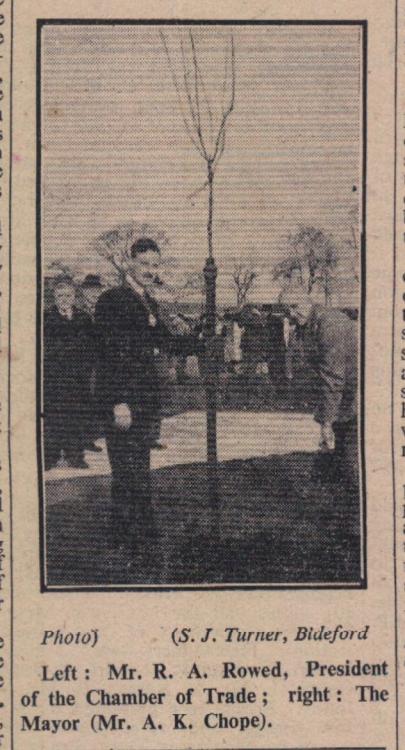
In 1950, a tree-planting ceremony took place in Park on March 8th. This was based on a suggestion by the Bideford and District Chamber of Trade when they decided on a gift of trees for the Victoria Park and King George Fields that they should form and be dedicated as an avenue of remembrance to those from the town who gave their lives in the recent war. Trees at the junction of two avenues of silver and Norwegian maples were planted by the Mayor of Bideford, Mr A K Chope, and the President of the Chamber, Mr J R Seward.
In 1951 the football club made an offer to Bideford. They had leased their part of the playing fields and fenced it along with other improvements, but could not get any further grants unless they were owners. So they proposed to “buy” it for a 21 year ownership period after which time they would return it to Bideford free of charge, subject to it remaining an FA playing field. The Burton at Bideford was opened in 1951 and the following year saw the formal opening of the playing fields by the Duke of Edinburgh:
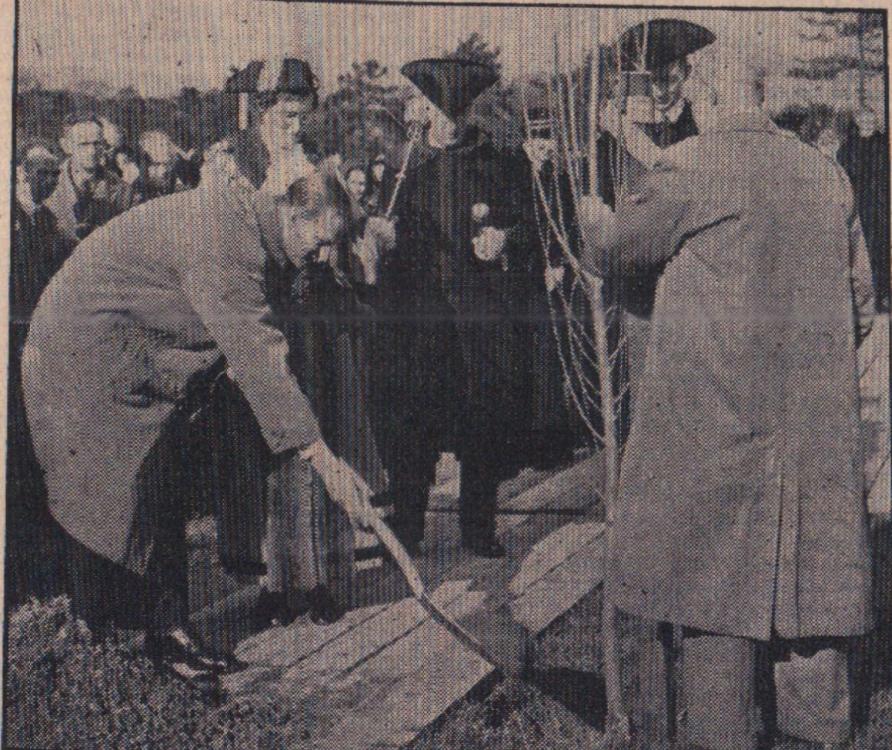
I hope this tree will grow comments the Duke, laughingly
"The main thing about playing fields was that as many people as possible should realise that they were obtainable if they really wanted them, said the Duke of Edinburgh when he spoke to the large crowds from a platform in the Victoria Park Bowling Green. “This scheme, from what I can see of it, looks a very wonderful one and it is a great example of what can be done by local authorities to help people who wish to play and wish to spend some of their time out of doors. I hope that if there are any other local authorities looking, listening or sitting on the grass, that they will take note of what can be done,” he said. Leaving the platform, and accompanied by the Mayor, the Duke went to a spot just outside the bowling green where he planted a Lombardy poplar, held for him by head gardener, Mr W Hill. Within the bowling green enclosure the Mayor planted a weeping willow which was held for her by Mr Reg Blackmore, a member of the Parks staff."
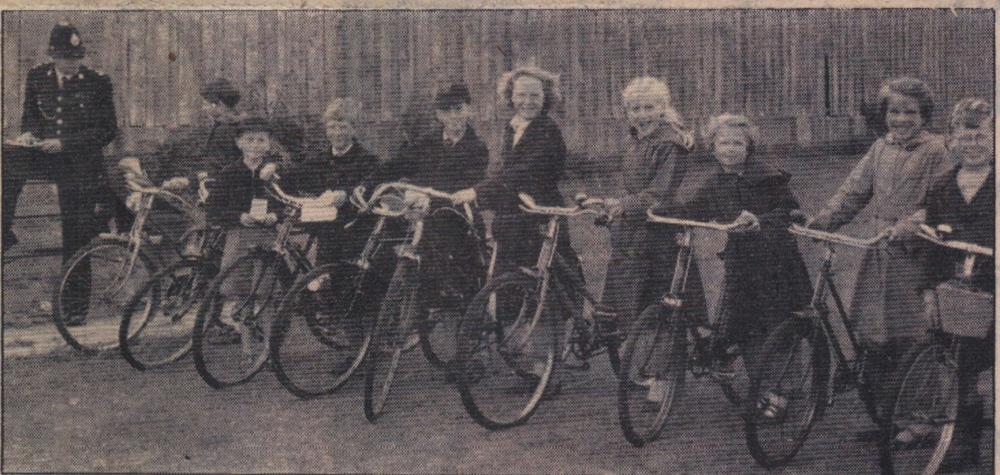
Further developments took place in the following years - tennis courts (in spite of reservations from some councillors that too much open space was being developed); a bowls club was founded in 1950; putting took place; rugby and cricket; Training Ship “Revenge” was reaching the end of its life in the late 1950s and the borough council offered a site on King George’s field adjacent to the A.T.C. hut, with the cost of the new building expected to be £600; cycling proficiency tests took place and Saturday mornings, childrens' entertainment was held in the Park. In 2000 a Millennium time capsule was also buried.
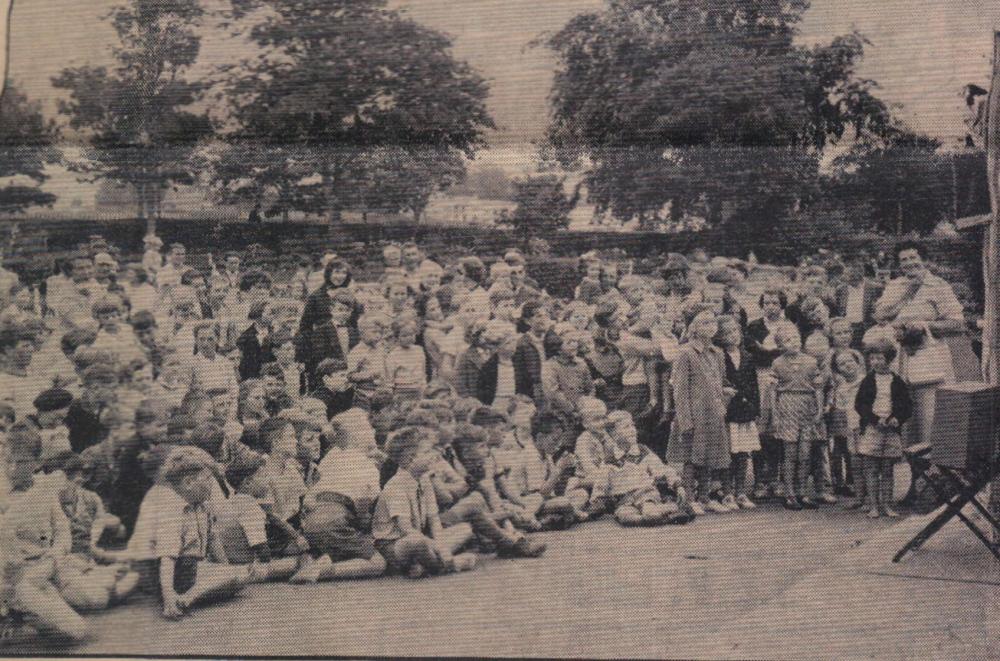
Holiday entertainment for children with Edwin the magician